Thursday, March 30, 2006

How to come to grief

Fancy them at your peril...


Part of my job involves coding types of cancer from medical reports, each one having it's own alphanumeric code. The book we use for this (which as you can imagine is very large, with each cancer and each body part having a specific code) also contains a chapter on 'External causes of Injury', full of things like being hit by cars, punched in the face etc. But it also contains some slightly less-common ways to come to grief. So with apologies to hypochondriacs everywhere, here are a few lesser-known ways to end up on a hospital admission form...


- accident caused by diving with insufficient air supply W81.0
- accident (transport) involving aircraft - sucked into jet engine V97.3
- assassination (attempt) (see also assault) Y09.0
- bean in nose W79.0
- beheading (by guillotine) legal execution Y35.5
- bitten by millipede, venomous (tropical) X26.0
- burn (electricity)(flame)(hot gas)(radiation)(steam) to testis T21.0
- combustion, spontaneous (see also ignition) X09.0
- contact with hornet(s) X23.0
- contact with meat slicer (industrial) W31.0
- dust in eye W44.0
- effects (adverse) of nuclear explosion (fireball) Y36.5
- falling from flagpole W13.0
- implantation of quills from porcupine W55.0
- lying before train, vehicle or other moving object (accidental) Y31.0
- mangled (accidentally) X59.0
- pecked by bird W64.0
- rowing, excessive X50.0
- spacecraft accident injuring occupant V95.4
- struck (accidentally) by law enforcement agent Y35.6
- suicide by steam, hot vapour X77.0
- thunderbolt X33.0
- twisted by person(s) (accidentally) W50.0


I love some of these. How on earth do you accidentally lie in front of a train? Or steam yourself to death? You'd lose none of your flavour though. Unsurprisingly, the book makes no allowance for any positive effects of being caught in a nuclear fireball (if there are any, they're probably only very brief). And all this assuming SMR06 medical forms survive the apocalypse - maybe cockroaches could fill them out, or something. Anyway, there are also 'medical' causes of illness and injury in there - not just unfortunate things that happen if you stand in the wrong place/push the wrong button/annoy a porcupine. Some of them have names you just couldn't make up - and would cause you no end of nervous fidgeting in a doctor's waiting room...


- bubbly lung sydrome P27.0
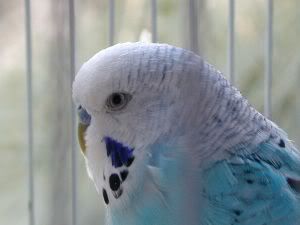
- budgerigar fancier's disease J67.2
(I kid you not)
- clam digger's itch B65.3
- coalminer's elbow M70.2
- devil's grip B33.0
- kinking hair L67.8
- moveable kidney N28.8
- overlapping toe M20.5
- testicular feminization syndrome E34.5
- whistling face Q87.0


and if it all gets too much...


- dropped dead R96.0

Monday, March 27, 2006

Lights Out

Take it outside...


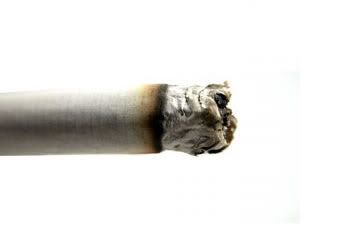
This weekend was an historic one for people living in Scotland, as it became the first part of Great Britain to ban smoking in all public places. It was heavily pushed by the Scottish Government - who are desperate to improve the health of a country with a life expectancy 10yrs below the EU average. Despite it being in the media almost continually over the past few weeks - with 20% of smokers prepared to flout the ban, authorities were somewhat relieved when the ban implementation passed off without a hitch.

At this point I should admit to having an interest here - if you don't know, I work as a Cancer researcher - so anything that helps keep people off my database is a good thing (especially on a Friday afternoon). Lung Cancer kills over 36,000 people in the UK each year* - 1/5 of all deaths - and in Scotland 35 people a day die from the effects.** Something needs to be done to reverse this, it's shameful.
But is banning smoking in enclosed public spaces the answer? I'm still not sure if it will persuade smokers to quit - I assume they'll just go outside or smoke more at home. I do know that as a non-smoker I used to hate the stinging eyes and stinking clothes that used to be the result of a night out - so for me, it has to be a good thing. The ban was brought in at 6am on Sunday - ironically on the day the clocks went forward and BST began. So not only did the discrimination of smokers start, they got an hour less in bed too. At least Gordon Brown didn't increase taxes on sausage suppers and Irn Bru.

By a co-incidence, I was in Boston on the day they went no-smoking, and remember plenty of signs encouraging people to smoke one last time 'Wave your butts in the air' is one that stands out. Sydney introduced a 'partial' ban, where bars and pubs had segregated smoking areas - so people who wanted to light up had to traipse to the other side of the bar. It was too piecemeal though, and some places didn't bother, others were totally no-smoking and the 'fag lepers' (as Viz calls them) had to stand outside - not much of a punishment given the Aussie weather.

Here though, it's a different story. You'll be pleased to hear I conducted some exhaustive research yesterday, and found many pubs now have benches and bins outside for smokers. A few more hopeful landlords had installed outdoor seating - but the freezing winds meant there was no Italian Piazza-style drinking on Rose Street, just hunched smokers puffing away in pub doorways. The website of Clearing the Air Scotland has the solution - a smoking shelter, that looks like something birds would use if they were waiting for a bus.

So in my opinion it's a great day for Scotland - fair enough it will annoy some smokers who I've heard complaining about being victimised, and the 'Nanny State'. But they've been victimising me and other non-smokers for years, so who cares. There's some fuss over it now - but soon not smoking in pubs will seem as everyday as not smoking at your desk (something people I work with can still remember). The aim isn't to stigmatise anybody - it's to help save lives and increase Scotland's health. The sooner it's introduced in England and Wales, the better...


[edit - it seems the ever-enterprising Scots have reacted to the ban in ingenious ways already. From the BBC...A man posing as a plain-clothes police officer ordered a woman who was smoking on a Glasgow train platform to pay a £20 on-the-spot fine for breaking the new Anti-smoking legislation. The lone passenger had been smoking a cigarette at Partick station at 1110 GMT on Tuesday when the man approached. He said he was a plain clothed police officer and gave her a fine. The victim handed over the money.

* [Cancer Research UK, 2002]
** [Health Education Authority]

Tuesday, March 21, 2006

The Wedding


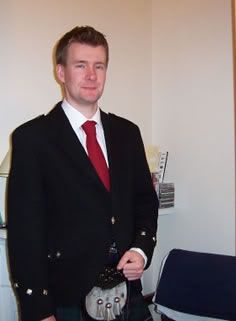
So this is your author all dressed up in the kilt and ready to go. Over the course of the day I perfected this catalogue pose - kilts have no pockets - so you need to hang onto something (no tittering at the back!). Felt great though - when I was walking through the city people were standing aside for me (true story), such is the respect of the Man in Highland Dress. Makes a change from pointing and throwing things, anyway. It's a heavy outfit though - even the tie is 100% wool. And to answer the question you're thinking of - 'nothing'.


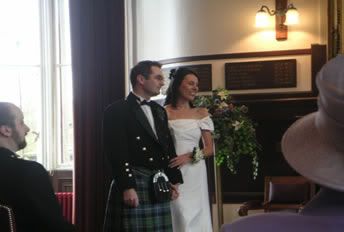
The happy couple becoming officially a happy couple, at the City Chambers in Dunfermline, Fife. Despite the gloomy weather, it was dry - albeit windy (an interesting sensation in a kilt). The registry office service was well done, and Michele got most of the way through her vows without blubbing. I was wringing out my hanky at that point...


I look like I'm trying to steal the Bride's big moment here - you can see Paul on the left leaning back out of the way (mostly). The reception was at a 4-star country hotel over the road from Dunfermline FC's stadium - and very nice it was too. Good food, plenty of booze, and a chance to catch up with people who had come from all over the country (and abroad). I should have elbowed my way in a bit more, though... ;)


It's actually against the law to get married in Scotland and not have a Ceilidh afterwards. A cheefully miked-up sergeant-major type was in charge of getting people up and explaining what to do. I'd been to one before, but everything was tough at first. The Scots actually learn Country Dancing at school, whereas we just used to play Top Trumps and swap football stickers. But after a while I picked up each dance - and then it promptly stopped and another one began of even more baffling complexity.


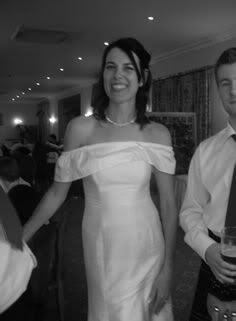
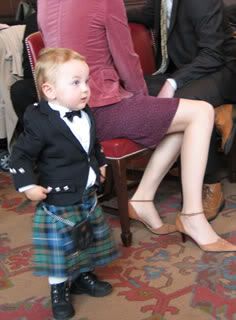
Despite all of us properly dressed up - only one man got the attention on the big day. Outshining even Edd the Groom (formerly Edd the Drummer) was his son Jack, here looking tip-top in his wee kilt. He spent the rest of the ceremony trying to run into the (empty) fireplace, and being restrained by the Best Man. Without doubt Jack ended up being photographed more than the happy couple - but of course nobody minded, least of all Jack.

Friday, March 17, 2006

Tartan-tastic

Taylor Tartan


Although I've lived in Scotland for a whopping 12 years, I've never worn a kilt. I'd never had any reason to - the one wedding I was invited to where Scottish formal dress was required I couldn't attend (I had another wedding on the same day in Wales). But this weekend two of my friends are tying the knot, Scots-style, so yours truly is donning the Tartan for the first time. They've come all the way from New Zealand - so you've got to make an effort, I guess. This was me visiting them in Wellington (I'm on the left).

So accompanied by my Scottish mate Grant - at least one of us knew what he was doing - we walked through flurries of soapy snow to Princes Street. One of the many twee Scottish shops there is Cameron Ross, which is all Tartan rugs and toy Highland Cows (or Hee-land Coos as they are pronounced) on the ground floor. Elbowing the tourists out of the way, we went up the stairs and asked to hire a kilt. We were then shown up a winding staircase, and through a series of doors, to the top of the building. On the way we passed stockpiles of shortbread, photos of Scottish views, and a battered hoover.

In the kilting room, a young girl took us through the stages - although Grant had hired one previously so it was just yours truly who got the attention. I was measured as high round my waist as old men wear their trousers, and down to the knee whilst my legs were bent slightly. She then picked out a couple of kilts in my size. You only have a choice of a few generic tartans - so as Grant had gone for the Black Watch, I went for the other one, Scottish National. Sean Connery would be proud. I then had to try it on, which involved wrapping it round like a towel and buckling it in place. Amazingly it didn't fall off - but I hadn't done it tight enough. "Although you need to be able to breathe" said the girl, cheerily.

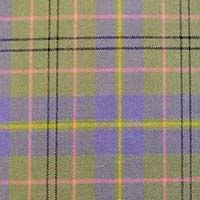
I was measured for a jacket and shoes - which involved a complicated method of tying I won't go into here, and was given socks and a 'Full Highland Accessory Pack' - which consists of a Sporran, Belt, Skean Dhu, Hose, Flashes and Kilt Pin. The Skean Dhu is the dagger you tuck into the top of your sock - but what with Scotland leading the world in knifings (Hello Glasgow!), it was plastic. I jokingly asked the girl if there was a Taylor tartan - and she replied that there was, which was news to me. So after we'd gone downstairs I searched the touristy shop for proof, and did indeed find it. As Grant said - "It's worryingly lime-greeny". And purple. You'd think a popular surname would have a decent colour-scheme, at least...

Tuesday, March 14, 2006

Walking near water

Kingfisher


When I leave the office at night, I have a number of choices when it comes to getting home. Getting a bus is the most obvious, as Edinburgh is well served by Lothian Buses - almost too well served in fact, as the maroon and white double deckers clog up the city centre on most days. When our office was relocated from the other side of Edinburgh two years ago (against the wishes of most of the staff), the Union got the management to lay on free buses for staff back into the city - a small victory for us faceless drones. So I often get that bus, saving £1 each trip. Of course, as regular DUaB readers will know, walking home is my favoured method.

The last long-distance walk home I had was on my daily sun-drenched stroll along the Sydney Harbour bridge and through Hyde Park. Very different now that I'm back here (temperature in Sydney yesterday 27C; Edinburgh 1C), but having moved into the new flat I at least get a different route from my old Edinburgh hour-and-a-half trek through slate-grey housing estates. Admittedly, the first hour of the new trek home is along the traffic-clogged Corstorphine Road, but once I get past Edinburgh Zoo it improves a bit.

Here they used to walk the zoo's penguins along the street - presumably to give them a bit of exercise, and to attract visitors - but the sheer bizarre sight of a line of Rockhoppers waddling along a main road lead to a number of accidents, so the practice was halted. Accidents involving distracted drivers, I should say, not penguin casualties. But when I walk past the zoo it's a short waddle to Murrayfield, and the scaffold-esque shadow of the rugby stadium is where I can turn off the main road and leave the buses and cars behind.

The final 45mins of the trip home is two miles along the Water of Leith footpath - a paved route that follows the small river flowing through Northern Edinburgh. Running from Balerno in the Pentland Hills to the mouth at Leith, the 12 miles of the river has a path all the way (I've walked it in the past). In my opinion, it's one of the secret joys of the entire city - very few people know about it other than those who live nearby and use it as a shortcut, or to walk their dogs. Tourists rarely find it.

The path is so quiet, you can only hear the water and the birds - forgetting totally that you're walking through the middle of a capital city. The river valley is sunken slightly, so it swallows sound, and the droning of traffic is only faint at worst. The path undulates, taking in rapids, weirs and dams, and at the moment the wooded hillsides are covered in crocuses and snowdrops. The first time I went home that way, I saw a Dipper hopping on a rock amidst the rushing water, and the second time, a Kingfisher blurred past me in a streak of blue. That was only the second time I've seen one in my entire life.

So I'll be walking along the path every day, if possible. Just this weekend we had over an inch of snow (gasp), so I took a few wintry pictures. If you're visiting Edinburgh and have a spare couple of hours - walk down Dundas Street to Canonmills (or take the 23 bus), then follow the signs for the Water of Leith footpath to Stockbridge. The walk takes you along the best sections of the route, and you can get a bus back from Murrayfield to the city. If you pass me, give me a wave...


More information on the Water of Leith can be found here.

Thursday, March 09, 2006

Bonus Paris photos


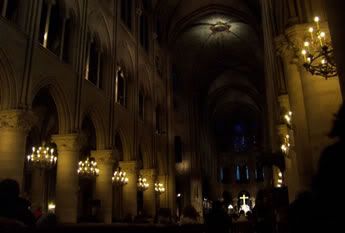
Notre Dame Cathedral is staggering in scale. The outside facade looms over you, in an extravagantly carved H-shape covered with life-sized statues of people ascending to heaven or being cast into hell. When you step through the creaking heavy doors everything goes black. Once your eyes adjust to the gloomy interior, this is what you see - arches stretching upwards out of sight, glowing candles, and in the distance a dazzling golden crucifix.


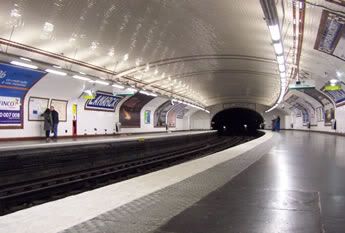
The Paris Metro is great - you can rattle around anywhere under the city for next to nothing. It's everything a city Metro should be - frequent, busy, dirty, cheerful. Many stations have buskers playing accordions or pianos. After the smooth, sanitised Tokyo Metro, it was good to travel about in Paris as you really feel you're underneath a massive city. This is Lamarck-Caulancourt Station, in Montmartre. Grant and Lan are there, looking at the map.


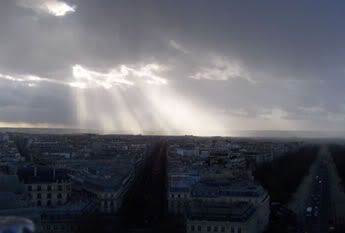
Greyness from the top of the Arc de Triomphe. There's a fantastic view from the top - identical-looking grey wedges of buildings stretching off in every direction, almost as far as the eye can see. Large wide boulevards run out like spokes on a wheel, clogged with traffic. We just dodged a rainstorm, and here the sun had started to weakly pierce the clouds and shine over the city again.


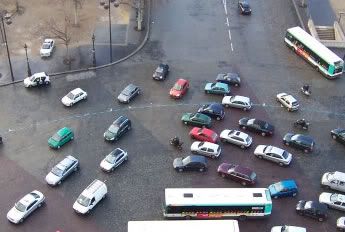
The other fun thing to do atop the Arc de Triomphe is to watch the traffic swooping round the Place Charles de Gaulle Etoile in un-coordinated mayhem. Somehow they seem to avoid eachother, although on many occasions it was a close-run thing. With no traffic markings, the cars, vans and bikes pile around until something blocks their path, then toot their horn until a space opens up and they can make a dart for it. It's almost mesmerising.


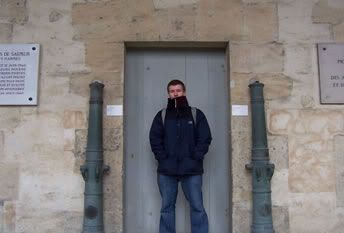
This is your author at the Musee de l'Armee at Les Invalides, essentially the French War Museum. Unfortunately, half of it was closed for renovation - but they did have a lot of cannons outdoors. If you're wondering why I'm wrapped up, it was below zero. I've been to Paris four or five times now - and always in winter when it's freezing. Next time, I'm going in summer...

Sunday, March 05, 2006

Solutions to a problem

Ampulex compressa


A while ago I did a 'serious' post about discovering the backstory to a beach I ate a sandwich on in Western Australia (here). Time for another one, this one prompted by a science article I read in another blog - the excellent, and award-winning Loom. You might not want to eat whilst reading this, as it's about insects.

They have always fascinated me, and the recent BBC Natural History series Life in the Undergrowth proved yet again how incredibly they behave. The other week I also saw a programme about Butcher Ants in Africa - the marauding wave of tiny killers that rampage along, shredding anything hapless enough to get in their way. I'm not about to get drawn into the Evolution/Intelligent Design argument here - as most people who know me know I'm firmly on Darwin's side of the fence (throwing a frisbee around in his garden, probably). But I can understand how some animal behaviour is seen by Creationists as proof that evolution couldn't come up with something as complex. The two examples below could be seen as being so utterly complicated they couldn't possibly develop over time. But I think they are the opposite - evolution in action.

The first belongs to the Butcher Ants, and for me is pretty much cast-iron proof that evolution happens. When the stream of ants encounters a creature that can't escape, they swarm all over it and nibble it to pieces. On the programme they found a slug - easy pickings, you might think. Well, no, as the slug immediately splurged slime all over the place, drowning any ants nearby, and giving it a private moat. If this had saved the slug in the past, the ants have now discovered - learned - a way around it. Incredibly, each ant goes away and picks up a jawful of earth. As the smug slug sits in his pool of gunge, each individual ant drops it's soil into the slime. What are they doing? They are soaking up the liquid. Eventually, so many ants have done this, the mucus puddle has dried up and the ants swarm all over the now hapless slug, tearing it to pieces. This is evolution happening in front of us. The slugs have developed a protective measure against the ants, and the ants have learned a way around it. Now the slugs that change their behaviour to win back the advantage (by producing fiery slime, or something) will survive, and those that can't, won't. This is Natural Selection in action.

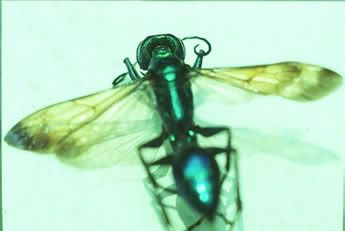
The second incidence stunned even me - and when it comes to invertebrates, I take some stunning. Unless it involves large spiders. This one involves a wasp - Ampulex compressa, which has to lay eggs inside a cockroach (I did warn you). Now if it stabbed a healthy living roach, and let it run off until the egg hatched, the host might die or get eaten - killing the wasp larvae at the same time. So the wasp has to incapacitate the cockroach, and hide it away. Some parasitic wasps sting their victim and drag it bodily back to the wasp's burrow - but Ampulex is too small, so has to do things a little differently. It prefers to get the cockroach back to it's own burrow - but of course they wouldn't exactly volunteer. So what the wasp does is astonishing. It stings the roach to stun it, then stings it again in the back of the head. Not just anywhere - it probes around exactly, until it finds the specific part of the roach brain covering escape reflexes.

Driving it's stinger home, the wasp removes the 'fear' part of the brain (for want of a better expression), and disables the insect so it can't walk unaided. The cockroach sits there obediently. So how does the wasp get to the burrow? It grabs hold of the roach's antennae and walks it there, like a dog. The roach follows, walking to it's home, and the wasp pulls it gently along, but lets it instinctively go home. There, the wasp stings it again, injects the egg, and walls the hole closed. The larvae then has a safe, protected place to develop, and a first meal on hand. In fact, the baby wasp is born inside it's first meal - like being born inside a giant pie. So the Ampulex wasp has overcome the problem of being too small to manipulate a massive cockroach by evolving the means to make the cockroach manipulate itself like a zombie.

Just think about the changes in behaviour necessary to give the wasp that ability. Discovering where to sting the roach without killing it, what part of the brain to aim for to make it subserviant, even what species of cockroach to prey on. Survival of the fittest. And this isn't a complex mammalian brain making these decisions - this is a wasp half the size of your little finger. The one downside of evolution, is that it happens so sloooooowly we can't see all these variations, all the tiny steps taken for the behaviour to develop. But I think we can see enough. Each stage of the battles between ant and slug, wasp and cockroach is part of this development. Now the ants and wasps have the upper hand - but if the cockroach develops a thicker head, the wasp's stinger might not reach. This would be the next stage. This is evolution in action - and I find it utterly, utterly fascinating.


For more about Ampulex compressa, the excellent article can be read here. It also has photos of the wasp stinging the cockroach.

Wednesday, March 01, 2006

Pancake Day

It's all in the wrist


It was a great week in Paris, but now I'm back in Edinburgh and back at work. While I was away the final bits of organisation and monetary matters were concluded, and a couple of days after I got back I moved into a new flat. It's a really good feeling to get a place after so much time spent looking, and I moved in over the weekend. The first few days in a new flat are always slightly strange - the oddness of waking up and not realising where you are, having to work out a new storage system for your pants, etc. The novelty hasn't worn off yet.

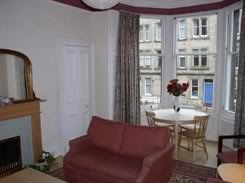
It's a traditional Edinburgh tenament building, all high ceilings and cornices. The ceiling of the living room is a stunning dark purple, and the newly-laid click-together wooden floor is still slippy if you walk about in socks (as I found out the other day). The lounge has an 'Edinburgh Press' - a door with shelves behind it. By some unfortunate irony the stairwell light shines through the window over our front door, then through a window above my bed into my room. It had developed a maddening on-off-on-off blinking, so as I was lying there the first night I felt like an enemy combatant being prepped for interrogation. The next day a few bits of cardboard taped to the window, and it was all the better.

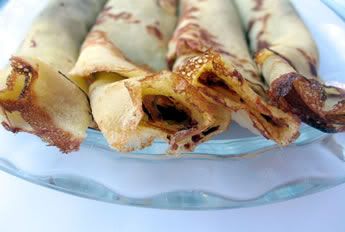
We celebrated the new flat in traditional last-Tuesday-in-February fashion, by having pancakes. There can be few foods that have a better easiness of preparation:great taste ratio (apart from handing a fiver to a chipshop proprieter). Blobbing the batter into a sizzling pan and quickly swirling it around becomes automatic after a while, and the pile of freshly-made pancakes soon builds up - only to reduce again almost as quickly. There was a certain irony as we watched 'You are what you eat' whilst stuffing our faces with pancakes. But our new IKEA coffee table looked great with all the fillings on it - honey, sugar, lemon juice, maple syrup, chocolate sauce, strawberry syrup, bananas, apples in caramel sauce, and two types of ice cream. You are what you eat indeed...

The lounge, with 'Press'

Sunday, February 26, 2006

Napoleon's Grande Tomb

He's in there somewhere


Napoleon Bonaparte was born on the 15th of August 1769 at Ajaccio on Corsica - which had only just been sold to France by the Italian state of Genoa. So by one of those odd quirks of fate, technically he wasn't really French. But by the time he died in 1821 he had become a national icon - despite being twice sent into exile over half a million people lined the route of his Parisian funeral in 1840. The state had to find a fitting resting place for the great man, even if he had 'never fully mastered French and his spelling left a lot to be desired,' according to NapoleonGuide.com.

In the end, the large ex-barracks and military hospital of the Hotel des Invalides was chosen, and his coffin laid in the Eglise du Dome that can be seen from all over central Paris. The large formal barracks building is crowned with a giant spired golden dome that rises brightly amidst all the other notable landmarks nearby. It was re-gilded in 1989 using 12kg of gold, and it certainly stands out. Although the church was begun in 1677, the monument was completed in 1861 when his remains were laid to rest. To visit, you buy a ticket that also allows entry into the Musee de l'Armee, which is currently half-closed for renovation, and walk back out to the front and climb the steps to the main entrance.

What hits you first is the sheer scale of the Mausoleum - the inner cup of the dome soars away above your head, covered in more gold and painted murals of the General's greatest triumphs. Large alcoves stretch away from the centre, each housing the tomb of a notable French military leader. Marechal Foch - the Allied Commander of WWI forces - has the most poignant, a life-sized grey marble statue of six French soldiers carrying his body on a stretcher. However, this pales into insignificance when you reach the centre of the church, and see the huge circular hole housing Napoleon's Tomb. Built into the crypt level is a mammoth red wooden casket made from Finnish Porphyry. Inside are five successive coffins (tin, mahogany, lead, lead again, and ebony), and inside that are the ashes of the man himself.

Egotistic isn't the word. If there was a statue of him and a large coffin, that would be understandable - but this monument is incredible. Walking down a set of stairs behind a gilded and mirrored altar takes you level with the tomb, and a large circular chamber. Here the walls are covered in marble frescoes of Napoleon in God-like poses handing out decrees to subserviant minions. One of the quotes on the wall translates as 'By it's simplicity my code of law has done more good in France than all the laws which have preceeded me'. He wasn't shy about self-promotion, that's for sure.

I wasn't really sure what to make of the tomb. Napoleon was undoubtedly a great figure and a leader - and he's still incredibly popular in France. Walking through the War Museum afterwards I could see how proud they are of their military tradition, and only Charles de Gaulle is comparable to the pint-sized Corsican. Someone of that legend should be given a suitable and fitting resting place. But although I was staggered by the scale of the thing - so the 19th Century designers had succeeded in their aim, it left me uneasy. I don't remember Wellington's grave at St Paul's Cathedral in London being anything like it. What about the 550,000 men of the Grande Armee who died on his madcap campaign into Russia? For me, one of the most telling things about Napoleon is that in the Eglise du Dome you'll find the grave of his son - buried under a statue of himself.

Wednesday, February 22, 2006

Grande Galerie

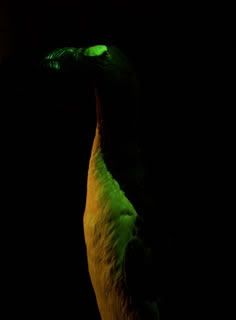
Extinct Giant Auk, or Penguine Grande


One of Paris's lesser-known indoor attractions is the Grande Galerie de l'Evolution, perfect for a wet and blustery Saturday afternoon. Part of the elegant sprawl of the Museum National d'Histoire Naturelle - Natural History Museum to you and me - to reach it you walk through the Jardin des Plantes, an elegant structured garden to the South of the River Seine. Originally laid out as a medicinal herb garden in 1626, the site has now become a sort of Botanic Gardens, with rows of neat muddy borders awaiting some Spring growth. Two large glasshouses dominate the garden - both of which are currently undergoing renovation and are closed.

The Gallery of Evolution (to give it an English name) is on the South side of the complex, next to an imposing grey museum of Mineralogy. My guidebook described the old-style museum buildings of Paleontology, Anatomy, Mineralogy, Entomology, and Paleobotany as 'musty'. Refusing to accept anything involving insects could be so categorised, we attempted to get into the Entomology Museum but were turned back by a book-reading academic at the desk who informed us it wasn't a museum, but a collection of specimens off-limits to the public. Musty old bugger.

So we piled out of the rain and into the Evolution Gallery - a 19th Century glass-domed building with four floors of stuffed animals and exhibits on the interactions between animals and the environment. It was very interesting, if hard to understand as 95% of the signs were in French - but a stuffed Polar Bear looks the same in any language. The bottom floor had all kinds of wierd aquatic stuff in jars, so that more than made up for our refusal at the Entomology Museum.

As it was, that was kind of fitting, as I discovered later that the frustrated Ecologist Jean-Baptiste Lamarck had been appointed 'Professior of worms and insects' at the Museum National d'Histoire Naturelle after the French Revolution. Perhaps in that very building he started to work on his radical theory about animals adapting to environmental pressures that preceeded Darwin's by many years (sadly he was derided and died blind, and in abject poverty). On the other side of the square was the building where Henri Becquerel discovered radioactivity (1896), and the Curies discovered Radium (1898) - so maybe best avoided, but wherever you go in Paris, you'll find something historic.

Monday, February 20, 2006

Avec les Nuns

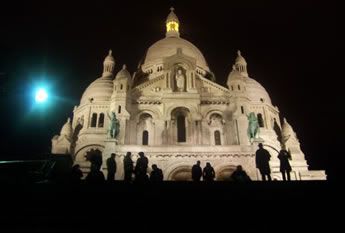
Sacre-Coeur at night


Friday night was the only time where all eight of us would be together in Paris (Tim would be the first to leave, on Saturday night) - so we went for a big night out. First we took the Metro to Chatelet and tried a French-style pizza, or Flam. According to the menu they originate in Western France, and apparently there is something different about the base - it certainly seemed more crepe-like than pizza-like; but it was good stuff. The restaurant was packed, and there was a great atmosphere.

After that we walked down to the Seine just in time to see the Eiffel Tower shimmer, as it does for a minute on the hour. I'd seen it before, but it always impresses me. I can't remember why they started it, but it proved so popular that the authorities decided to keep going. Hundreds of thousands of light bulbs flash on and off, and the entire tower sparkles - it really is something else. Also down by the river we came across a sudden commotion and a rushing group of rollerbladers appeared, followed by blaring police lights and motorbikes.

At first glance it looked like they were being chased, but it was the legal street run that takes place every Friday night - hundreds of skaters whizz through the roads, which are temporarily closed to let them go safely. Originally it was illegal, started by some hardcore types, but eventually the sheer popularity of the event forced the police to legitimise it and offer an escort to cut down on accidents. The route changes every week, and if you've got some skates you can join in, apparently.

A trip on the Metro later and we were in Oberkampf, a suburb in Eastern Paris. Erika had arranged for some of her friends to come out, and we had to meet them at a place called the Nun's Cafe. Not sure what to expect, we turned up and found a small, smokey bar with not a Nun in sight. Nobody seemed to know why it was so called, but nobody seemed to care either. We stayed there until it closed at 2am, driking the local beer out of small glasses and trying to speak French to Erika's friends - who needless to say were all fluent in English. I think my French actually improved the more I drank, which is something I'll have to remember for the future...

Saturday, February 18, 2006

Napoleon's Grande Arc

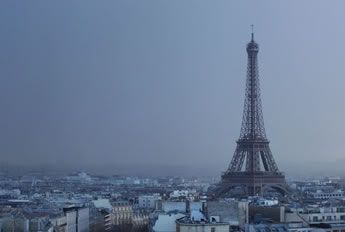
Rain sweeps past the Eiffel Tower


In all my previous visits to Paris, I'd never been to the Arc de Triomphe - so we took care of that today. A quick rattle along le Metro to Charles-de-Gaulle-Etoile and we popped up at the imposing archway, looming over the traffic. Begun by Napoleon in 1806, it wasn't finished until 1836, and stands as a monument to France's armies. The traffic around the base is something to be seen, but thankfully an underpass spirits you to the base of the Arch without the need to risk your life above ground. The underside of the Arc is elegantly carved with the names of 660 Generals and various battles in which they distinguished themselves. Also underneath is an eternal flame to commemorate an unkown soldier from the Great War.

For €8, you can climb almost 300 steps to the top, which has a small museum to Napoleon and the campaigns of his time. Maps and plans of the Battle of Austerlitz line the walls, together with reproductions of the big man's battle tent and living quarters while he was overseeing his armies in action. He didn't half do things in style. A few more steps brings you blinking onto the roof, with stunning views all over Paris. In some respects, it's better than the view from the Eiffel Tower (as you can't see the Tower when you're up it).

Radiating off in all directions are imposingly straight roads, lined with tiny people rushing about, and clogged with cars and buses. In the distance the slight rise of Montmartre is given away by the pinnacle of the Sacre Coeur rising over the buildings. In the other direction are the tower blocks of the business district with the enormous square of la Defense sticking up like the other goal on a giant football pitch. The views are fantastic, especially looking down at the madcap traffic, as vehicles funnel into and out of the Place d'Etoile like blood cells shooting through veins.

We stayed up there for about half an hour, watching a storm cloud run over the East of the city. Eventually the rain reached us and arrived almost horizontally, whipped in by the strong wind. Taking cover behind one of the walls at the top, there was just time for another photo of the Eiffel Tower before we dashed down for the dryness of the interior and the long trek down the steps to ground level.

Friday, February 17, 2006

The most famous...

Ou est la Joconde?


Is there a more famous museum in the world than the Louvre? Not that I know of - and despite this being my fifth trip to Paris, I'd never actually been inside. Today was another dull grey morning, perfect for indoor things, so after a quick Metro trip into the city we found ourselves walking through the blustery Jardin de Tuileries towards the famous glass pyramids. The original Palais de Louvre was constructed in 1190 by Philippe-Auguste as a place to store his weapons, but it wasn't until 1360 that a king (Charles V) decided to live in the Palace. Eventually art was stored there, and it opened as an art gallery in 1793, the same year Louis XVI met his untimely and painful end. It also proved a convenient place for Napoleon to store his massive amounts of war booty, so the collection grew and grew.

Today it houses hundreds of thousands of paintings, sculpture, relics and artefacts from all over the world (which was news to me - I thought it was just paintings). To get in, you join a queue to descend an escalator for a cursory bag check, and then line up to pay your €8.50 - not a bad price when you think about it. The Museum is laid out over three enormous wings - Denon, Richelieu, and Sully. Just standing in the foyer gives you an idea of which is the most popular - Denon - because of one very special painting.

If the Louvre is the most famous museum in the world, then the Mona Lisa is without doubt the most famous painting, and of course the Louvre's star attraction. We were pulled along in the tide of people walking briskly past masterpiece after masterpiece when the corridor opened up and turning to the right, there she was. I had wanted to take a picture of the crowd of gawkers looking at it, but photography was strictly not allowed - ostensibly to avoid harsh flashes damaging the painting (sheltered behind a double layer of darkened bullet-proof glass), but the massed ranks of reproductions in the gift shop must have had something to do with it.

It's a beautiful painting, there's no denying it - but I wasn't blown away by the majesty of la Joconde as some are. Admittedly, I know very little about painting and art, but the other early renaissance pictures there were just as impressive - it's difficult to see just what makes that particular one stand out. Still, it was nice to look at for a while, and I guess that's what paintings are all about.

After the 'large Italian artworks' we wandered through the rest of the Denon wing, and by chance found ourselves in a small gallery of indigenous art from the Pacific region - a relatively new addition to the more traditional arty stuff. They even had an Easter Island stone head. The throng of people had thinned here, but increased dramatically as we wandered along the lower Denon through classical Greek sculptures. After a slight detour through a wonderful section of Roman mosaics, we came on a long pillared corridor with the Venus de Milo at the end. I hadn't known it was in the Louvre, so we had a close look and tried to avoid getting in the way of photograph-takers. It's a stunning statue, although all I could think of was the episode of the Simpsons where Homer goes to the candy fair and ends up stealing the jelly Venus de Milo and having to run for it.

At this point, we'd been in the Louvre for hours - hours of culture and enlightenment - but still hours. Around the Egyptian antiquities section we ran out of steam. When mummies don't get your interest levels up, you know it's time to go. So in the end we'd seen barely half of the Louvre's treasures - but at least we'd knocked off the 'big two' and seen a few more interesting bits and pieces, from Roman daggers to genuine Totem poles. And here's me thinking it was just paintings...

Thursday, February 16, 2006

La Cité

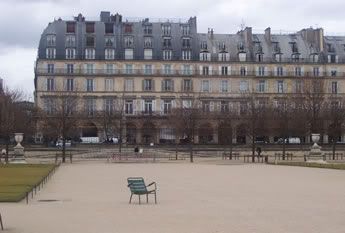
Jardin de Tuileries


So, I'm back on the road - in Paris. I started off yesterday arriving on a tiny plane from Edinburgh (only about 20 people on board). The massive grey Charles de Gaulle airport was deathly silent, and I managed to get to the gare and find a train for the centre of Paris. I was due to meet my friend Erika at the Gare du Nord, but she was having her hair done and I had to wait around for a while at the station.

She soon arrived though, and we walked to her studio flat (a French euphamism for tiny flat) and dumped my stuff. We had picked up some cakes on the way, so before I'd even taken my shoes off I was tucking into the good stuff. We had to scoot over to Porte Maillot to meet another friend who was arriving from Beauvais airport, then went out for dinner. Erika was getting a few admiring French glances for dining out with two men on Valentine's Day - this is Paris after all.

The next morning, Tim and I set off to wander around in the light drizzle, and covered a fair proportion of the touristy stuff (it was his first time in Paris). The top of the Eiffel Tower was closed because of the strong winds, so we continued our ramblings, stopping off for a few cakes - it's got to be done. By 4pm we'd walked so far it was all we could do to stumble onto the Metro back to Chez Erika and flop on the sofa. Fortunately, a Japanese dinner revived us, and we went to a tiny bar near the Sorbonne, full of glamorously smoking students watching the rain drip through a crack in the ceiling...

Saturday, February 11, 2006

Every man's worst nightmare

Come in number six...


No, not a giant jellyfish (more of that later) - but a disrupted Saturday routine. The traditional Saturday afternoon of sport on the telly, that great British tradition, ruined by the very worst...a broken television. The coupons had been placed, the tea freshly brewed, the papers on the table. It was all going so well. For the past few weeks the TV has been making odd squeaking noises, and suddenly turning itself off without warning. We thought this was just a defence mechanism whenever Celebrity Big Brother came on, but recently it's been getting far worse. Yesterday I spent the last of my pools winnings on a new Xbox game, only to be stymied by the TV turning itself off nine times in twenty minutes.

This afternoon the telly finally gave up the ghost, turning off seconds after it was turned on. Every time we pushed the button it would instantly shut down like a tetchy child not wanting to play. And all this was just as Sky Soccer Saturday was coming on - you can't get worse timing. The programme where a panel of football experts watch the live games and describe what's happening (to get round the rules preventing showing of live games at 3pm on a Saturday). As my Mum describes it - "Men watching men watching football". The wrecked television prompted us to sink to increased levels of bizarre desperation - as we plugged the digital receiver into the hi-fi, and became 'Men listening to men watching football'.

What with Match of the Day on later, not to mention the Winter Olympics (or the Olympic Winter Games as they seem to have re-branded it) - desperate measures were called for. When you stand a chance of missing the biathlon, I think you'll agree you've got no choice. So we went into the city to buy a telly. Sadly, the major retailers don't stock TV's anymore - they have display models. You choose the one you want, and it gets delivered within 28 days. "28 days?", I squawked at the bloke in Dixons. "But it's the women's moguls on in an hour!!". He looked at me like he didn't care whether I lived or died, and informed me that their warehouse is expecting a delivery in two weeks.

So we trudged home in what had become pouring rain, and took the TV apart to fiddle with the dusty wiring. After putting it back together, nothing was happening, and I was just about to reach for a book and read (on a weekend!!) when astonishingly the telly spluttered into life and stayed on for more than thirty seconds. That was four hours ago, and we're too scared to turn it off. We even managed to watch the women's moguls (what does that do to the knees?) - so crisis averted. I put down the hammer, and the book stayed in the glass case.


So next week I'm off travelling again. Yes, this erstwhile travel blog will move away from talk of trainers and flags and get back to why it was started. Although if I eat any good pies, you'll be the first to know Michele. I'm going to Paris for a week to catch up with my old friend Erika - I've not been there for a couple of years, so am really looking forward to getting back. In total, 7 of us are going over, so it should be a great week. Until then - au revoir, and salut maintenant...


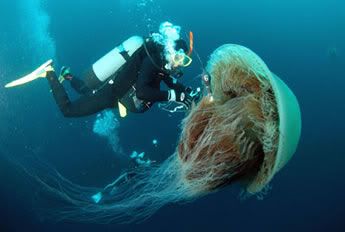
Oh, the jellyfish. I just liked the picture. Giant Jellyfish invade Japan

Wednesday, February 08, 2006

Vexillology

Where's the dragon?


The study of flags.

When I was younger, I was a committed vexillophile. Before the News of the World send a hit-squad round to get me, I should say that it means 'someone who loves flags'. Why did I? I can't really remember - probably the mixture of exotic-sounding foreign names, far-away places and bright colours. I remember a 'Flags of the World' poster I had, which I knew so well I can still describe almost any flag at random. Of course, this is utterly un-useful - apart from during an old episode of The Amazing Race on the TV where the contestants were in the Philippines and had to land their small boat on whichever island had the national flag on it. Before we'd seen any of the options, I turned to my flatmate and said 'White triangle with star, upper blue band, lower red band', causing him to inch his chair away from me slightly.

If you like colourful rectangles, you should pay a visit to Nationmaster.com, which has over 49,000 flags, of every country in the world and then some. From the Cypriot Police Force to the Scout Association of Kazakhstan, if it has a flag, you'll find a picture of it there. Want to know the flag of the Bulgarian Ministry of the Interior in 1955? No, thought not. Still, if you did, it's on Nationmaster. Here are some of my favourites...


Qasigiannguit, Greenland.
Not enough global flags feature prawns, in my opinion. Here is the website of Qasigiannguit, which is written in the local language that has some of the longest words I've ever seen. Want to have a stab at pronouncing oqaluttuarisaaneranut? The flag represents the prawns that are the life-blood of the town, in their cooked and raw state. The 'friendly' town is situated in the improbably-named Disco Bay.


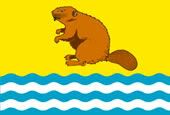
Municipality of Bievre, Namur, Belgium.
Bievre...Beaver. I get it. Not sure why it's by the seaside - but it looks mightily annoyed. Must have lost his frisbee, or something. Bievre is twinned with Desborough, Northamptonshire.


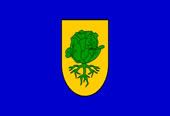
Vidovec, Varazdin, Croatia.
I don't know what Vidovec means, but it probably doesn't smell that nice there.


Municipality of Ciney, Namur, Belgium.
I presume this design is an old heraldic motif of squires or pages or something, but it just reminds me of a prog-rock video.


Aklavik, NW Territories, Canada.
This one's tremendous - it features a book, a rat, and the motto 'Never Say Die'. After a bit of crafty Googling, I learned all about the 'Mad Trapper of Rat River' - presumably he of the 'Never Say Die' attitude, as it took seventeen men and a strafing from a fighter plane to bring him down. They obviously breed them tough up in Aklavik.


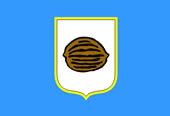
Orehovica, Medjimurje, Croatia.
I wonder if the walnut-people of Orehovica live near the Cabbages of Vidovec?


Nezdenice, Czech Republic.
Many European flags have heraldic backgrounds. This one is by far the best. It seems to be based on the limbless Black Knight from Monty Python, stabbing himself through the head with his sword. Watch out for that menacing-looking giant key though.


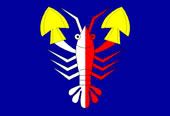
Rakuvka, Czech Republic.
A lobster juggling mushrooms - something you don't see every day...

<

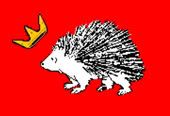
Coudekerque-Branche Municipality, France.
I know the French like to play boules (or they do on TV programmes I've seen), so this 'throw the crown on the hedgehog' could be a local variation. Maybe you win a goldfish if you manage it.


Sicily, Italy.
'When Yoga goes bad'


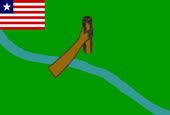
Lofa County, Liberia.
Absolutely no idea - it seems to be an arm planting a sausage aross a river. Symbolic?


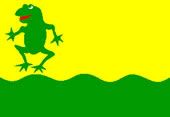
Hijum, Netherlands.
'So what shall we put on the flag guys?'
'How about a dancing frog?'
'Why not?'


Thanks to Flags of the World for descriptions and pictures.

Monday, February 06, 2006

Super Sunday

'Ooh! Me nuts!'


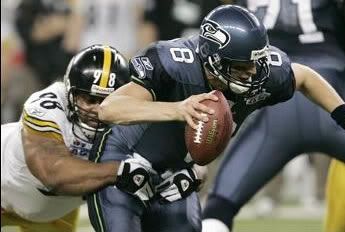
Yesterday was 'Super Sunday' - the annual orgy of consumerism that surrounds the final game of the American Football season. As usual, I stayed up to watch it - although last year in Australia it was on at breakfast time, which was odd (beer and cornflakes don't really go together). The game this year pitted the Seattle Seahawks against the Pittsburgh Steelers, and after a slow first half the Steelers wound out winners by 11 points. After Janet Jackson's 'wardrobe malfunction' of two years ago, this year's halftime show (the lengthily-named 'Super Bowl XL Sprint Half-time show featuring the Rolling Stones') was supposed to be family-friendly. I was delighted to learn that two of out their three songs were censored by panicky TV executives. The five-second delay obviously paid off as they saved the global public from hearing Mick Jagger complete the fantastic couplet:-

One time you were my baby chicken
Now you've grown into a fox
And once upon a time I was your little rooster
Am I just one of your c****?


Answers on a postcard...


Apart from archaic censorship, American sports are dominated by statistics and numbers. As an enthusiast of stats and facts, I collected a few Super Bowl facts. Enjoy!

- Fans at the game ate 5,000lb of hotdogs, which stretched end to end would reach 5 miles

- 24,000 cans of soda were sold at the Superbowl - more than 85 elephants drink in a day

- Super Bowl XXXIV (2000) ads cost an average of $73,333 per second

- Eight percent of those watching will be tuning in just to see the ads.

- In 1999, ABC made dot-com advertisers pay in advance for time in the advertising showcase

- Super Bowl ticket prices over the years: Super Bowl I (1967) $6-$12; Super Bowl XV (1981) $40; Super Bowl XXII (1988) $100; Super Bowl XXX (1996) $200-$350; Super Bowl XXXIII (1999) $325; Super Bowl XL (2006) $620 (£350)

- A commercial in the Super Bowl will reach 40% of all U.S. households (40 million out of 100 million or approximately 90 million people in the U.S. alone)

- Superbowl weekend will have fewer weddings than any other weekend in the year

- 6% of the American workforce will call in sick on Monday

- 20% of Super Bowl viewers stated they liked the TV ads more than the game

- 38% of people made some type of wager on the Super Bowl

- More Americans watched the 2004 Super Bowl than voted in the 2004 presidential election.

- Half of all Americans would rather go to a Super Bowl party than a New Year's Eve party.

- Two out of five Super Bowl watchers are not even football fans.

- 13% of Americans order takeout/delivery food from a restaurant for a Super Bowl gathering. 58% of them will choose pizza.

- On Super Bowl Sunday, Americans will eat an estimated 20 million pounds of potato and tortilla chips and eight million pounds of avocados.

- Sales of antacid increase by 20% on Super Bowl weekend.

- 35% of those who attend the Super Bowl write it off as a corporate expense.

- 58% of people would rather take their bathroom breaks during the game than miss the commercials.


sources
SuperBowl Monday
Official Super Bowl XL website
The Center for Research on the Effects of Television, Cornell University

Wednesday, February 01, 2006

Academics Anonymous

Do they have these anymore?


According to a recent survey carried out by a market research company, University students think their lecturers are 'stuck-up, disorganised, unpunctual, unfunny, badly dressed and too desperate to be "hip"'. As reported in the Times and by the BBC, the responses from 648 students found many thought academics were "snooty" and had "objectionable facial hair". I found that amusing, as I remember most of my lecturers would fit the bill exactly - in fact, I wondered why the press seemed to find it so surprising. Mind you, I did study science - a discipline where wild facial hair and crazed expressions seem to be a pre-requisite.

I studied at two Universities, and always marvelled at the mannerisms of some of my lecturers compared to those from other departments. There's something about the Biological Sciences that encourages oddball behaviour, and the longer you spend in that environment, the more infected you become. My supervisor at my first University was a cycling obsessive - so much so that he used to spend all day in his lycra biking outfit, lectures and all. He was a great bloke, if amazingly scatterbrained, and looked exactly like Richard O'Brien from the Crystal Maze. That photo's uncanny, actually. I once left him a vital form to sign, and when I went back a few days later he spent 20mins looking for it. Eventually he found it in the bin, uncrinkled it, signed it with a flourish, and handed it over. I've just checked the staff website, and was pleased to see he's still there.

Another character was a silver-haired biology lecturer who was once described to me as a 'bit of a ladies man' by another member of staff (I have no idea why he told me). He did actually have an affair with a student, but I can't remember if he had to leave because of it - he's not there anymore. His trademark was a large silver belt-buckle of his initials - which mirrors one of the main findings of the poll - "The poll suggests that many students find their lecturers' attempts at being trendy insufferable". I once went to see him to discuss an essay I was writing about deep-sea fish, and he raised a finger with a sudden cry of 'Ah-hah!', and rooted around in a cluttered cupboard before bringing out a blueish deep-sea fish in a test tube. I can only guess as to how long it had been there - or what else was in the cupboard. I once found a dried seahorse on the dashboard of the department minibus.

Academics also have a bizarre sense of humour - I once noted in an ecology paper I wrote about the problems of accurately measuring saplings with a tape measure (because I couldn't reach the tops), only to find the lecturer had written 'SHORTARSE!!' in the margin in red pen. Another left a binliner of fish for us to study in an unplugged lab fridge over the weekend (on purpose I always thought), so when we turned up on Monday morning to sort through them the smell was so awful it almost made the entire class ill. Ahh...happy days...

Monday, January 30, 2006

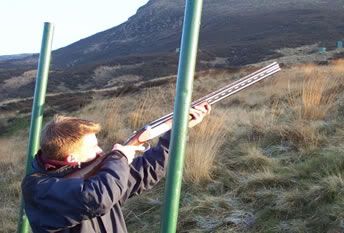
Blasting away at clay

'PULL!!...*BANG*...bugger'


This is your author clay pigeon shooting - or more accurately blasting away at the Derbyshire countryside whilst a tiny clay disc whizzes past, unharmed. One of my oldest friends from back home (in both senses) was celebrating his 30th over the weekend, so a few of us went to Manchester to see him. After driving over from Preston on a bright Saturday morning we linked up in a convoy and drove into the Peak District - which I learned recently is the second most visited National Park in the world behind Fuji-Hakone NP, where I was on a very un-bright weekend a few months ago.

We rolled through to Glossop, and then on to Crowden - half a dozen scattered houses in a wind-swept but striking valley. Up the hillside was the Boar Shooting Ground, overlooking the Torside Reservoir. Thankfully a misnoma - the only things we'd be shooting would be clay pigeons (and bracken, in my case). Now I've never held a gun in my life, so was looking forward to it - but also a bit nervous as to whether I'd hit anything. As it happened I hit the very first one I aimed at - but then nothing for a long while. We had split into groups of four, and as my mate Oliver goes shooting all the time (he brought his own ammo) the owner let him look after three novices - me and old schoolfriends Alex and Phil. Stages were marked out with scaffolding poles stuck into the ground like fenceposts (so you didn't wheel around and shoot over other people), and the clays were launched with a hand-held button (we still shouted 'PULL' instead of 'PUSH', though).

Oliver goes shooting practically every weekend, and is - and I'm sure he'll take this as a compliment - a ruthless machine. Clay after clay shattered into fragments, shrapnel spinning into the long grass in every direction. The rest of us were somewhat less effective, and managed to hit a few - I got 7 out of 30. Not too bad for a first go. It's difficult though - for a start the gun is longer than I was expecting, and pretty heavy. You lean into it, pressing it into your shoulder. This automatically tenses you up, so when the clay flings out of the bushes, you jerk around and try to follow it. Being smooth is the best way to hit one, and you follow the trajectory of the disc until you can't see it behind the end of the gun, and squeeze the trigger.

At this point, the shotgun kicks upwards and there's a earplug-shaking BANG. If you're lucky (or Oliver), the clay explodes into shards. If you're me, it continues to spiral merrily onwards and plops into the heather fifty feet away. I did get better, we moved around to different stages - designed to replicate a different kind of bird. I was pretty good at the one which comes directly at you at about 20ft in the air. I don't know what kind of bird that is (apart from suicidal), but using Oliver's special semi-automatic shotgun "Don't put your finger in the chamber, it'll take it off", I hit 4/5 (and more importantly retained all my fingers). At this point, a real-life pheasant wandered over to see what we were up to - which is as unadvised as a rabbit turning up to watch a greyhound race. The gunshots didn't seem to concern it, and after a while it hopped through a farm gate and away, unflustered...

Thursday, January 26, 2006

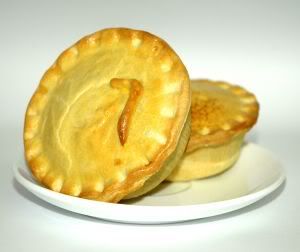
The beauty of pies

Mmmmm...


I'm from Lancashire - so I like pies. Admittedly, I'm not from Wigan - the centre of the pie universe - but near enough. I was eating a Steak pie supper from the local chippy the other night, when I thought I should blog something about the greatness of the pastry case full of odd meat and vegetables. I should start by saying that this is a British blog - so all references to the p-word are involving 'savoury' pies, not fruity imposters like you get over the Atlantic. Try ordering Pie and Chips in the US, and see what you get. Apart from odd looks.

After a quick Google, I discovered that pies were invented by the Ancient Egyptians. Despite being fruit-based, I was delighted to learn that ...drawings of this can be found etched on the tomb walls of Ramses II, located in the Valley of the Kings. Ah, if only Indiana Jones had broken into the Temple of Pies ("I've got a bad feeling about this, Shortcrust"). I hope the hieroglyphics have side-on men with bird-heads holding a deep-filled Pastie. Later on, the first meat-based pie was created by the Ancient Greeks - a flour/water paste wrapped around meat to seal in the juices. When the Romans conquered Greece, they brought back the pie as one of their spoils of victory. "Hail Ceaser! We bring you this gift of Steak and Kidney!".

I used to eat a fair few pies at school, where Butter Pie was on the menu at least once a week. I could only find one mention of proper Butter Pies on Google - here - the rest being Butter pastry pies or Peanut Butter Pies (?). Essentially potato and onion pie, it probably was less than 50% butter. Good hearty food for schoolkids. So that's where I get it from, I suppose. Of course, pies are supposedly unhealthy, so I only eat them as part of a balanced diet of course - which in Wigan is a pie in each hand. Had to get that in somewhere. What's a kebab in Wigan? A pie on a stick. Hoho. Pies also go with football - I can remember one match at Blackburn where the half-time rush (which starts well before half-time) were queueing under the stand when Rovers scored. They were asking us what had happened, but of course didn't relinquish their spots in the queue.

As part of my research for this post - yes, you read that correctly - I looked at a few of the UK's major pie producers (or pieducers, if you will). As you should know, the number 1 branded pie in the stadia market (according to their website) is Pukka Pies (motto - 'Don't Compromise'). They only use 'young lean bullock beef cut from the forequarter. No head meat, no mechanically recovered meat and no cow meat. This has always been the case.' Honest. Although their range does include something called 'Catering Sausage'. Yum. Hollands Pies (motto - 'Every Pie has it's moment') have five pages of pies on their website, including the Cheese and Onion Pastie which contains '8% Cheese and 4.5% Onion' - and obviously a lot of something else. However, they claim a blind test of 'over 30 people' found their pies to be the best - 'The new Steak and Kidney pie has the edge...in the two most important areas - taste and texture'. On the other side of the pie lid, as it were, are Square Pie (no motto) - a London-based posh pie chain with fillings like 'Jerk Chicken' and 'Wild Mushroom and Asparagus'. Set up in 2001 because 'we believe the world needs better pies. The word pie had become synonymous with rubbery pastry and dodgy fillings you didn't trust', their website has poems and 'pie-stories'. No Catering Sausage here.

So it seems pies are here to stay. As bad for you are the chippy pies (cooked by being dropped into the chip fat), upmarket and gourmet pie sellers are putting the upper back into the crust. The rise of the middle-class foodie has meant an increase in popularity of regional variations like the Bridie and Cornish Pastie. Hopefully meat pies are making an impression in the tricky North American market - Steak and Kidney pie seems to be a euphamism for the perceived nastiness of British food. Pies are certainly going strong in Australia - the classic Pie Floater (a pie drowned in mushy peas) is a delight, and I sampled a few at Harry's Cafe de Wheels in Sydney, something of a national treasure. So I urge you all to enjoy your pies. If you need inspiration, have a look at the quite brilliant I Like Pies who have a 'Piemate of the Month'. So I'll be tucking into one of those soon. I still draw the line at Black Pudding, though.