Sunday, April 29, 2007

Pink Week

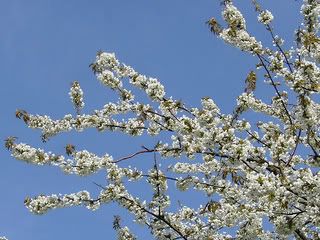
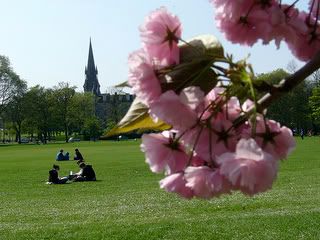
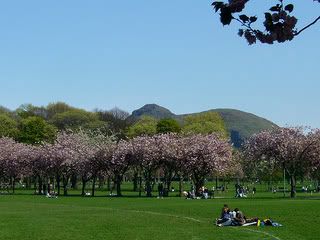
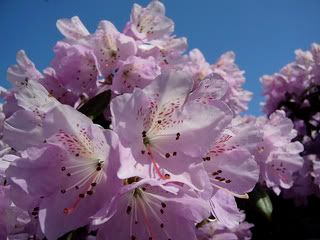
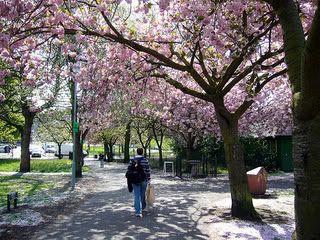
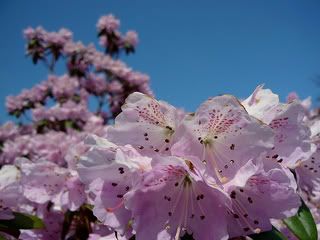
According to the papers today, Scotland is headed for it's warmest April since records began. This weekend the weather was dry and sunny, and as the Brits tend to do, everyone piled outside to make the most of it. Edinburgh is currently going through 'Pink Week', so the sun was much appreciated. Unofficially named by local students, it's the few days every Spring where the city parks explode into life with tree blossom. It's not just the Japanese who love the 'sakura', we've got it over here as well. The two best Pink Week viewing locations are the Edinburgh Botanic Gardens (fairly obviously), and the Meadows park towards the south of the city centre. I lived just off the Meadows for many years, and never tired of the spectacular floral show at the end of each April. The Japanese see them as a metaphor for the ephemeral nature of existence - and with good reason, as within a few days all these blossoms will be gone.


White blooms near my office


Students 'studying' in the Meadows


Arthur's Seat hides behind a pink hedge


Closeup from the botanic gardens


Jawbone walk, the main pathway across the Meadows


Another closeup - note the blue sky!


Monday, April 23, 2007

Hair Crimes

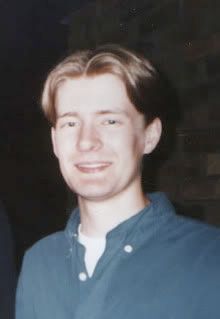
Your author, circa 1997. Curtains!


So I was getting my monthlyish haircut over the weekend, during which I learned that the girl who regularly attempts to hack into my spiky shagpile comes from the same Polish city as my Aunt (hello Gosia!!). Slightly odd, as I thought she was Spanish (the hairdresser, that is). But then, I've only been going there for eight years. I managed to impress her with my awesome pronunciation of Wroclaw, which I'd be willing to bet you can't take a shot at*. It's the second-largest city after Warsaw, and is in the Lower Silesian Voivodeship, as I'm sure you all appreciate. That's a word my spellchecker returns as 'Volvo dealership'. Anyway, we talked about our collective knowledge of Poland for a while - her twenty-odd years compared to my pronunciation of one urban area. I'm glad my Auntie isn't from Bydgoszcz, or I'd have had nothing to say at all.

Haircuts are peculiar things, it's the single thing you get someone else to do that has a major impact on how you look. Hence the trepidation many people feel about them. Tonsurophobia is what you have when things get really bad. The 'International Hair Directory' HairFinder.com has an article about the subject, written by a Psychosocial Therapist. In it, she postulates fear of getting a haircut may be a sign of a greater problem, such as social anxiety disorder or personality issues. There are dozens of hairstyle websites out there, many trying to help those with haircut anxiety by featuring stunning pictures of knockout celebs, like the lovely Scarlett Johansson. Thankfully Hairfinder has a Hair Chooser where you can upload a photo of yourself (men and women both) and generate all kinds of wacky do's - but alas it costs US$15, so you'll have to make do of the photo of me above.

Firstly, I was obviously pale and drawn because of all the hard academic work and all those hours in the gym working on my six-pack. Secondly, center partings were all the rage in the mid-90's. They were hard to keep up with, though, far more complicated than my current "shave round the back and chop into the top, prosze." I remember once getting some old duffer in a place outside of Stirling, who hacked into the back like a pensioner going at a privet hedge, then blowdried the front until I looked like George Michael. But hey, I bet there's not one of you out there who doesn't have at least one hair crime in their past. Student days are clearly the best time for these, as the new found freedoms kick in and either youthful exuberance or destitution result in cracking combinations of lengths and colours. I've never changed colour, but I've certainly changed my length (as it were), the time I got the whole lot shaved off was great fun, until I realised that I instantly resembled a pink kiwi fruit.

As I can't do a post without mentioning Wikipedia, I had great fun with their 'notable hairstyles' section (go to the link and scroll down a bit). Duck's Ass, anyone? I put that into an online Polish translator, and it came back wonderfully as 'kaczka osiol' "Kaczka" sounds like the noise a duck might make, if it had a heavy cold, and "Osiol", well... Worried waterfowl aside, there are so many different types and styles of haircut these days, that pretty much anything goes. Even mullets seem to have come back, every day I see some catastrophic alignment of edges and highlights. Kevin Pietersen has a lot to answer for, although it's worth pointing out Shane Warne had that hair surgically implanted, and it still looks like he's got a bird on his head. Maybe it's a kaczka osiol. Anyroad, the good thing with modern hairstyles is that if you are unfortunate enough to get a terrible haircut, it seems you will be in good company.


* It's pronounced rotswoff. Gold star if you got it...

Monday, April 16, 2007

Fancy a pint?

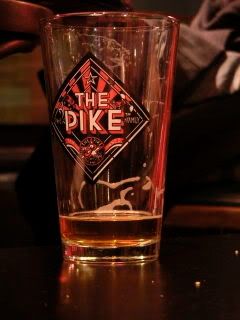
The Pike Bar, Seattle


The blogging Spring cleaning continues apace - with DUaB sorted out in it's new look (unless you happen to be viewing in Internet Explorer, but I'll get on that soon), attention has been turned to the brand new kid on the block - The BeerCast. A new blog from a panel of enthusiastic amateur boozers (myself included), we aim to offer an interactive forum for lovers of all types of ales. Come over and see for yourself, as we take one country at a time and review some of the choicest - and not so choicest - beers on offer. As we have to record our tasting sessions for notetaking and soforth, we may well cobble together a podcast (the BeerCast of the title), so watch this space. Or rather - watch this space...

The BeerCast

Thursday, April 12, 2007

Good for what ails you

Mmmm


I've been thinking a lot about beer over the last few weeks. Not just on an amateur level, either. The new beer blog (still not finished, but getting there) gives us plenty of opportunity to increase our knowledge. Of course, when you dabble with the drink, it can come at a price. Hangovers - or 'vesalgia' to give it the proper medical term - are never fun, and yet many of us are happy to take the trade-off they involve to have a decent night out. Several times a week, if they are students. But how to combat them? Wiki has a list of possible remedies that vary from the reasonable - drinking water and taking paracetamol, to the bizarre - eating cactus fruit, swimming in cold water, masturbation (the old 'It's for my hangover, dear!' excuse).

Scotland has it's very own ready mixed Hangover cure, of course - the mighy Irn-Bru. Due to a high sugar content and freakish combination of minerals and who-knows-what, it does help with the headache and dehydration. But it's not enough, so it's advisable to combine it with that other great British invention, the All-Day Breakfast. I love the introduction to it's page on the aforementioned Wikipedia - 'Fry-ups are no longer an everyday occurrence in most British households although they occupy an important place in the English concept of the morning meal. They are the predominant business of many greasy spoon cafés as well as generally being offered to tourists as traditional fare in hotels, guest houses and Bed and Breakfasts.' Quite.

A proper home-cooked fryup is a joyous thing - golden free range eggs, perky mushrooms, thick floppy bacon. The list of alternatives is almost endless, and up here you have the added complication of haggis, black/white/red pudding, potato scones and so forth. Take the time to find the right ingredients and cook it yourself, and it's a world beater - and not necessarily unhealthy. But what if you don't have the ingredients to hand, or an easy shopping trip away? Bearing in mind that with a pounding hangover you aren't likely to be down the local organic market sourcing fresh produce. You need to turn to convenience, to the easy option. And what could be easier than having the entire fryup pre-cooked, and in a tin?

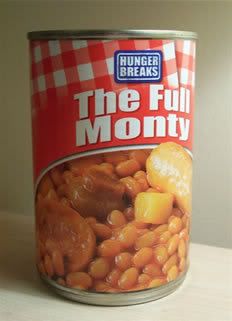
Hunger Breaks - The Full Monty just screams out from the supermarket shelf, with the fake tablecloth pattern and glistening photo of goodness within. Produced by HL Foods of Spalding, Lincolnshire, it falls under the considerable umbrella of Premier Foods, who seem to manufacture almost everything for sale in the UK - they own Cadbury, Sharwoods, Hovis, Mr Kipling, Branston, Oxo, and many others. But Hunger Breaks is surely the jewel in their crown - just a quick glance at their product range and you can feel your arteries harden. They have five tinned delights - All Day Breakfast, Chicken Curry, The Big BBQ, Sausage n' Wedges, and The Full Monty. Yes, you read that right - tinned sausages and potato wedges. Lovely.

So what wonderments make up the latter of these? The enticing blurb on the back of the label reads - 'Baked beans in tomato sauce with large sausages, potato chunks, button mushrooms, mini bacon steaks and a mini chopped & shaped beef & cereal cutlet.' In reality, this consists of - baked Beans (22%), water, tomatoes (15%), pork sausage (13% - themselves made up of a whopping 49% pork), potato (9%), button mushrooms (6%), bacon slice (5%), beef chop (3%), sugar, and then various flavourings and extracts. Polishing off the 410g lot will rack up 340 calories, 16g of fat and 3g of salt. The first thing that happens is the 'chopped & shaped' beef and cereal cutlet dissolves under the most gentle of stirrings, so small pieces of mince fragment into every mouthful.

This is a pity, as it makes it all taste very similar and limits the fun of plucking out the 'bacon slices' - which have indeed been chemically formed into the shape of a rasher of bacon (it must be the Sodium Diphosphate 'stabiliser'). After the first few forkfuls, you can feel it sitting there in the stomach like a lead weight - but picking at the bits becomes addictive, and soon the whole thing has gone. The best bit - probably the sausages, which of course don't taste like anything else. The worst bit - the feeling of creeping dread that you've just done something very wrong, something that you really shouldn't have. As you waddle back into the kitchen with the plate, the authors of your fresh and exciting cookbooks look down on you from their sea bass and endive-pictured covers, with a look of disgust. That's the worse thing. Oh, and the nausea.

Monday, April 09, 2007

DUaB Mark 2...

Hello again! Sorry for the downtime over the last few days, I've been wrestling with the wonders of html and blogging tools. Or rather, finding lots of free template sites and doing a fair bit of cutting and pasting. Anyway, after three years of using one of the default Blogger templates, it was time for a change - and this is the result. Hope you like it, I certainly do. Thanks to Final Sense for the ready-to-go templates, although of course the header I had to cobble together myself. That's what bank holidays are for, of course - DIY. In these modern cyber times, it's not just phsyical things you can do up, online property can be smartened. Plus it's my 300th post, so another reason to mix things up a bit. The layout might have changed, but the content won't too much (so apologies for that).

Before I get back to posting normally, here's a story I read about over the Easter break. A 25yr old Croatian man was arrested at Zagreb airport when customs officials saw his suitcase bulging. When they opened it, surprisingly it contained 175 chameleons. The man, named by the Guardian as Dragos Radovic, bought them in SE Asia when told by a local that they become invisible. Smuggling invisible animals sounds like the perfect get rich quick scheme - but unfortunately when plonked en masse into a suitcase they don't all take on the colour of the bag lining. Instead of an empty case, the officals saw 175 green chameleons (which don't change colour when stressed), and promptly arrested him for smuggling and animal cruelty.

So once again, as if proof were needed - crazy schemes never seem to work out in the end. Speaking of which, if you're a fan of beer - check out The Beer Cast. An amusing look at the most popular drink in the world. Hopefully we'll get it online by the end of the week, so if you get the dreaded 'private only!!!!' message, check back in a few days.

R


Edit - it seems there might be a slight formatting problem with the blog if you use Internet Explorer. I'll try and sort it out as soon as I can...

Tuesday, April 03, 2007

Bonus London photos


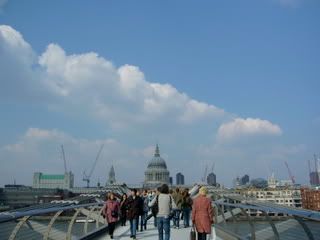
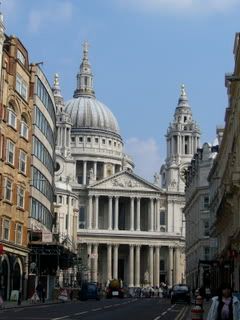
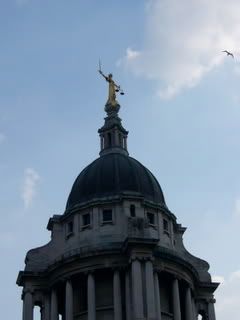
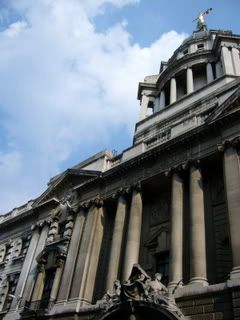
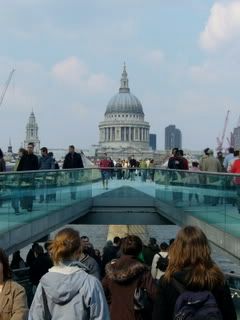
My short period of shooting about over Europe has sadly come to an end, as I'm back in Edinburgh working away again (until the Easter break on Friday, of course). Here are some photos I took last Saturday afternoon in London, which was superbly busy on a sparkling Spring day. I walked around two great buildings for picture takers - the Old Bailey and St Paul's Cathedral, before crossing the wobbly Millenium Bridge and walking along the south bank of the Thames for a while. The last photo is the relaxing end to a hectic week - I just about recovered from the 4:30am start - and celebrated with a well-earned complimentary G&T on my BA flight back to Scotland. I don't usually - but well, when it's BA, and it's free - one might as well, eh?


St Paul's on a sunny London afternoon


The Cathedral peeks out from buildings on Ludgate Hill


A seagull wheels past Lady Justice, the Old Bailey


London's oldest courthouse looking imposing


St Paul's as seen from a busy Millenium Bridge


Finishing off a successful trip in style


**BREAKING NEWS**BREAKING NEWS**BREAKING NEWS**BREAKING

It's a cut and thrust world, this blogging lark - you need to innovate, or you stagnate (or something - I was never very good at motivational management-type speak). So over the Easter long weekend, changes will be afoot for DUaB. After several hundred posts and almost three years - it's time for a change. So in a frantic burst of Spring cleaning, after Easter DUaB will return invigorated, with a new look. Also - and hang on to your hats - a new blog will spill forth from these tired, Wikipedia-abusing fingers. Yes, your author is branching out into another blogging sector. More soon, more soon....

Friday, March 30, 2007

Early Bird - Early Starts?

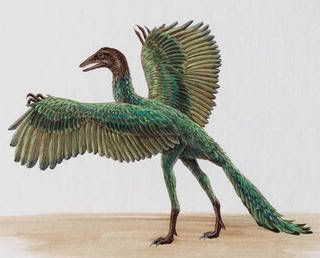
Archaeopteryx - a truly early bird


What's in a saying? Yesterday I had cause to think about 'The early bird catches the worm', and what it means. Phrases.org ('you'll probably find something here to interest you!') list the meaning of that particular nugget as "Success comes to those who preapre [sic] well and put in effort." Like putting effort into spelling, perhaps? They attribute the birth of this adage to John Ray's Collection of English Proverbs, written in 1670. I wonder how John came up with his saying - presumably he was sitting in his post-Elizabethan kitchen munching on some precursor of the crunchy nut cornflake and watching the blackbirds in his garden. Those that flapped down late from the surrounding trees missed out on their wriggly breakfast compared to the first few individuals. Dropping the bowl into the sink, the next addition to his new book of proverbs hit him "Yes! I have another - the bird that arriveth late to said party, misseth outeth on yonder Oligochaete bounty! Hussah!"

So Phrases.org seem to impy the saying means if you preapre - or prepare - in advance, plan carefully, you'll come up trumps in the end (itself an entry in the phrase database of course, derived from an old card game called triumph, apparently). Anyway, these days, the 'early bird catches the worm' has almost universally become applicable to things happening to those who arrive first, or get up the earliest - a la the blackbirds in John Ray's garden. Sales, special offers, competitions - these all offer incentives for those of us who can summon up the energy to crawl from our beds before sunrise. Of course, if you live in Scotland and get up before noon, you usually get up in the dark anyway. One rather amusing irony in me considering this phrase is that for a while I actually had to catch worms, as I was studying their numbers in various eastern English estuaries. So I can unequivocally answer that the early student doesn't catch the worm, as I was in bed with a hangover and went in the afternoons.

So why was I thinking about this particular phrase yesterday? Probably because I was busy thumping the alarm clock as is bleeped maniacally at 4:15am, rousing me from dreaming about Rovers winning the FA Cup. I had a meeting to attend in London, so needed to catch a 6:30 flight to the other capital, in order to be at Guy's Hospital for 10am. When you have to get up that early, there's a sense of disbelief when the alarm sounds, as you can't quite imagine it's that time already. But my clock is made by Oregon Scientific, so it must have been right (anything with the word 'scientific' in or on it has to be believed, surely?). By the way, looking at their website, surprisingly it pictures their products used by fit and healthy-looking model types studying, working out or otherwise bettering themselves - no pictures of bleary-eyed northerners punting their products across the room for forcing them out of bed in the middle of the night.

So, here I am in London. Only four days after mooching about on the Paris Metro, it's the Tube this time. The flight was fine after my early start - I'm not sure I caught any worms, but I learned some more interesting stuff about cancer. And besides, I've caught tens of thousands of worms in my life, I reckon I shouldn't disturb them any more than is necessary. One thing that amazed me was how busy Edinburgh airport was at 5am - long queues for all the flights connecting with other UK cities, people going to meetings or catching onward flights. A party of Egyptians in front of us in the queue had all kinds of luggage problems - how do you decide what to remove when the check-in desk lady curtly instructs you to take 2kg out of your suitcase? We got our boarding cards and walked past him, furtively rooting about in his luggage for things he didn't need back in Cairo, armed policemen eyeing him suspiciously.

The upshot of my Early Bird activity was by about 2pm I was seriously flagging - but of course as my boss reads this, I was still highly alert and motivated, taking copious notes and thinking of piercing questions to ask. By the time I got to my Grandparents in north London, I was just about done. After one of my Grandad's special pie and sausage combos, that was it. I went to bed and slept for almost twelve hours, as the worms of this part of the city rooted about in the ground, safe in the knowledge that I was coming nowhere near them...

Monday, March 26, 2007

Provins Problème

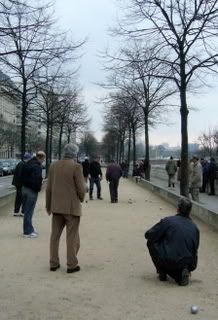
Sunday afternoon Pétanque


Awkwardly-received gifts can be a real nuisance sometimes. Not just the stereotypical Christmas jumper - but all kinds of other things too. In AD133 Henry I of Champagne (a kingdom with boozy coronations, no doubt), was given the head of a saint, of all things. Saint Quiriacus lived as Judas Cyriacus, when he happened to direct Empress Helena to the possible whereabouts of the 'true cross'. This "have you tried digging over there?" helpfulness got Judas baptised, made Bishop of Jerusalem, and then martyred in a truly horrible way by the persecutions of Julian the Apostate. Somehow his head was acquired by Henry I, probably under the influence of his native brew. "Wow. Guys, that was some session last night, eh? Ow. So, what happened? I didn't get pissed and buy anything stupid again did I? Hey - why is there a receipt for a Saint's head in my wallet?"

Why do I mention this? Well, Henry brought the head back to France and decided to build a cathedral around it. In time, this grew to a small town, which in medieval times was the centre of the region. A series of well-timed protection orders meant the architecture of Provins (as the settlement was called) was safeguarded, and has since become one of the classic walled medieval towns of Northern France. Sunday was our chance to walk these ancient cobbled streets, and maybe poke about in a few saint's head-related touristy gift shops. However, the bloody clocks went forward, and we missed the train. I was already struggling to adjust to the +1hr of CET, changing times on my watch, alarm, Macbook, iPod, etc etc - totally forgetting that they had to advance another hour. So we arrived at Gare d'L'Est with half an hour to spare, bought tickets (€20 apiece), and casually noticed the lack of any Provins-bound trains on the destination boards. Erika asked a ticket information person - the next train for Provins was at 5pm. That would be a quick day trip.

So - we had an emergency Sunday day out in Paris. When I lived in Sydney, if I had such an occurrence, I'd go to Manly. Always the same, always great, always plenty to do. Being in one of the world's greatest cities as we were, it wasn't hard to find something to occupy us for a few hours. The weather was bright and sunny - something of a shock for me - so we wandered along the canal amongst relaxing Parisians out with their dogs, kids, bikes, cans of beer. They were sitting outside cafes in sunglasses looking at everyone who came past, clanging petanque boules around in giant cat litter trays, ruefully flicking through day-old copies of Le Monde and wondering whether to plump for Sarkozy or Royal. They were also gathering in their hundreds outside the Hotel de Ville - we inadvertantly blundered into a mass rollerblading rally to celebrate Frances' 50th year in the EU (I think). They were giving out free tshirts - if you know me, you can imagine the Richard-shaped cloud of smoke that appeared as I belted over to get one.*

We walked for miles, through twisty backstreets and main boulevards, into the Marais where every person in Paris was crammed between the buildings, shopping in one of the few areas where everything was open. Here tourists got in the way of locals, who spilled onto the narrow roads getting in the way of scooters who cut up cars. Women cycled along with dogs in their baskets, people gripped dark, twisted baguettes like looted treasure, at one corner of the Place des Vosges arcade a classical quintet chello'd out a number for the crowd. Everywhere you looked there was a classic Parisian scene. It really is one of the best cities in the world in which to stroll around, there is always something to look at, something to catch the eye. Every time I leave Paris I realise a little more how much I enjoy going there - and every time I leave I promise to myself I'll be returning as soon as I can.


* because it was a tshirt, not because I saw something free...

Saturday, March 24, 2007

The Green Peril

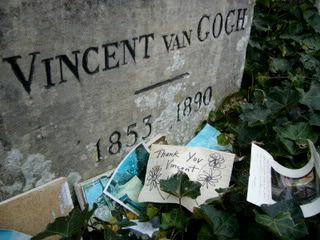
Items left at van Gogh's grave, Auvers-sur-Oise


In 1890 Paul Gachet was a village doctor in the small town of Auvers-sur-Oise, 16 miles north of Paris. He was also an amateur atist, and a serious hypochondriac. Because of his regard for the arts, he became renowned for treating painters for their many foibles and illnesses, advising amongst others Manet and Renoir. In May of that year, Camille Pissarro wrote to the good doctor about another troubled genius from the impressionist movement, Vincent van Gogh. Before that time Vincent had been staying at an asylum in Saint-Rémy, near Arles. He realised that if he moved north, he could live near his brother Theo, and talk through his issues with Dr. Gachet. So he moved to Auvers-sur-Oise.

As you can see from the photo above, it didn't go too well for him. He had a spectacular two months in the sleepy town, producing approximately seventy oil paintings in seventy days. His first impression of Dr. Gachet was not good - "He is sicker than I am, I think, or shall we say just as much." I'm not sure what Vincent thought of his new surroundings - he certainly cranked out some amazing art in that short period - but to me it looked like a typical French village as we turned up this afternoon on a battered local train on a day-trip whim (courtesy of the Rough Guide to Paris). Coming out of the station, a signpost pointed the way up an alley to the graves of the van Gogh brothers, so we followed it through the church grounds depicted in one of his final works.

Past the church the lane continued on, out of the shelter of the buildings and into an open field. The weather was still grey and cold, and the wind was fairly belting off the countryside as we scurried along to look at the simple headstone of a painter we knew little about. Eventually we found it, next to Theo's (who died of syphilis six months after Vincent shot himself in the stomach, in that very field). Covered in ivy, the small graves had merely the names and dates of the two brothers, Vincent's made slightly more remarkable by the offerings left by present-day admirers. There was nobody else around, it seemed as if the entire place was deserted - but thankfully we found a modern-looking restaurant open and had a fantastic three course meal for €20 apiece - terrine of rabbit, roast lamb and barley, and a selection of local cheeses. C'est superb!

Afterwards the weather was so rubbish something indoors was the only option. We had two choices - the Vincent van Gogh Museum, or the Absinthe Musem. So, apparently absinthe is derived from the mixture of certain herbs, including Anise, Fennel and the one nobody has ever heard of - Grand Wormwood. Initially given to French colonial forces in Algeria to ward off dysentary, it became the Parisian intellectuals' drug of choice (or one of them, at least) as the toxins it was said to contain had psycoactive properties. Entirely unrelatedly, sometimes manufacturers would add Zinc or Copper to make the liquid a more greenish colour. Yes - we walked past the van Gogh museum, and eargerly forked out €4.50 to find out more about a drink that tastes utterly vile. Or in my case, look at the pictures and then Google it when I got back to Paris to find out what it all meant.

The drink was banned in France in 1915 - giving me a good chance to use my legendary 'absinthe makes the heart grow fonder' joke (normally very hard to get into routine conversation - but when in a museum dedicated to the stuff, a crime not to wheel it out), not that it got a laugh. It's still banned today, although 'Wormwood based drinks', are not. It's definately still illegal to manufacture in the US, but not illegal to own it there. It was never banned in the UK, however (hoorah!). Apparently the gift shop of the museum in Auvers-sur-Oise is one of the few legal vendors of the stuff, and there were indeed several bottles behind the proprieter. But we had to make a sharp exit after I was caught taking photos inside, against her instructions, so I never got the chance to buy any. Not that I would, as it's truly disgusting stuff. Vincent van Gogh drank a huge amount of it during the last seventy days of his life - it was rumoured to have a significant effect on his mental health. He called it 'The Green Peril'.


Absinthe Museum website - apparently you have to be of legal drinking age to view this link - so don't tell your parents. Also, that's the woman who had a go at me for taking pictures, not unreasonably I have to say. This was the photo in question. Worth it, I think...

Friday, March 23, 2007

Gris à Paris

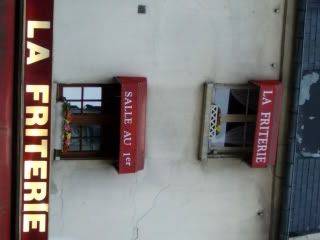
Ou est la friterie?


So, here I am once again in Paris - I think this is my 6th visit now, possibly 7th. Only an hour from Edinburgh, but a completely different vibe going on (as you'd expect). I say only an hour, but in reality I left my flat yesterday at 11:30am and got to my friend Erika's at 8pm. British Airways, in their wisdom, decided to sell their BA Connect airline - the carrier for the Edinburgh to Paris CDG route, so until the new owners have sorted themselves out there were no flights available (or they had totally sold out). Either way, I had to travel the lengthy alternative via Glasgow, then Prestwick, then Beauvais "This looks like Cumbernauld Airport!" said the man in front of me at the arrivals queue - it is basically a tent in the middle of nowhere. Anyway, by the time I popped up from the Metro at Erika's local station, the neon signs for Tabacs and Pharmacies let me know exactly what country I was in.

The next morning, it was grey, cold and windy - as it always seems to be when I come here. So after a leisurely morning involving several pastries from the local boulangerie, we indulged in the age-old Parisian tradition of aimless wandering around the streets, punctuated with the occasional cup of coffee in a small, smoky cafe. After a while the leaden sky turned to heavy rain, and we quickened our pace a bit, ducking into the odd shop now and again. The highlight for me was undoubtedly coming across a large group (10-15) of Chinese tourists animatedly watching a man trying to parallel park a battered black Renault. The space he was going for was far too small, but being Parisian he nudged and bonked his way in (bumpers are for bumping, after all), each collision causing the crowd to shriek and point. Glaring at them, he eventually parked and rolled down the window, shouting at them in French, which Erika translated as along the lines of "This isn't a show for tourists! Why don't you piss off and go on a guided tour?"

Monday, March 19, 2007

The Birthday Bridge


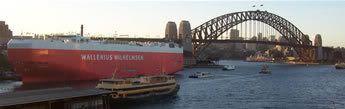
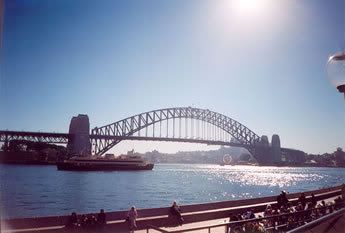
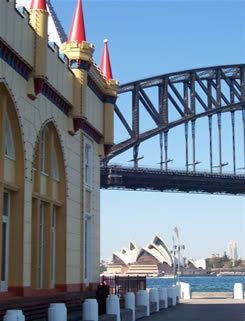
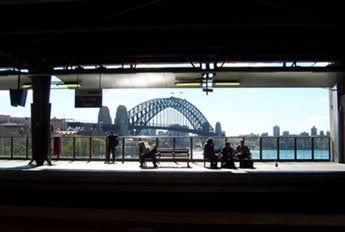
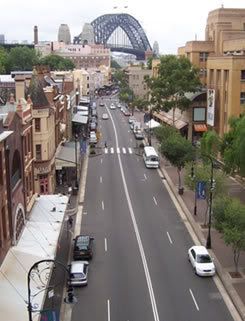
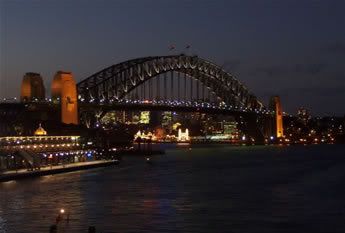
Today - the 19th of March - sees a very special birthday. If I had only a single card to send, it wouldn't be to Bruce Willis or Ursula Andress (and not just because they have yet to thank me for the Christmas card). It would be to that modern wonder of the world, the Sydney Harbour Bridge. It was officially opened 75yrs ago today, minutes after it was unofficially opened by a disgruntled sword-wielding army officer. I love the Harbour Bridge, it was a pleasure to see and travel over it when I lived in Sydney. By train on the way to work, I'd stand by the window so I could look out, even though I'd seen the same view the day before. Walking home from Milson's Point, as the sun was setting over the harbour, is one of my abiding memories of my time there. So to celebrate, here are the pick of the photos I took of the 'Coathanger' - the birthday bridge.


Shimmering in the sun, as the Manly ferry glides past


Three Sydney landmarks in one shot


From Circular Quay metro, I can't think of a better view from a station


Towering over the Rocks, wobbly streetlines and all


Blurry fireworks at New Year's Eve 2005


Crowds of people on Australia Day


Minutes after my final walk home over the bridge, at sunset


Harbour Bridge Celebrations [Sydney Morning Herald]
History of the bridge

Thursday, March 15, 2007

Dinotastic!


The other night on BBC2, the corporation's premier science outlet Horizon began a new series with a programme about dinosaurs. As I've mentioned before in various posts, I had a serious dino phase as a youngster - in fact almost all seven year old boys love them, I think it's in the rules along with liking throwing stones in water, getting dirty, and being generally insufferable. Later on as a biologist I began thinking about fossils in a more complex light than "Wow! Fossils are COOL!" (although admittedly only slightly more complex), I started wondering about what it would be like today had some things not happened the same way. Like if we'd flopped back into the sea, instead of starting to shimmy up trees. Or begun feeding our young by regurgitating food like seabirds. But one of the outcomes I've pondered off and on over the years most of all was the subject of this Horizon documentary - what would it be like if dinosaurs hadn't become extinct, and we lived here in modern times alongside them?

It was done in a half-jokey fashion, much to the annoyance of some of the following day's TV critics (the perennial 'dumbing down' debate). But the lengthy assumptions made in the science meant it needed to be done in a light-hearted manner. It's all just conjecture, namely the examples given had dinosaurs present as we commonly imagine them alongside our evolved selves - e.g. the idea that small dinos might have developed a similar urban role to foxes and raccoons. There was a great clip of a woman shooing a couple of them out of her bins - she should follow my Grandad and weight the lids down with bricks. Of course, reptiles had a head start over us of several million years - so allowing for development at similar rates, maybe we should be rooting about in their bins?

This was also touched on at the end - the idea that adapting to the changing Earth would have prodded dinosaurs into even more of a bipedal, upright method of getting around, in short - would they now be humanoid? Wonderfully, the programme finished with a selection of what looked like Dr Who extras shopping in a supermarket alongside normal-looking humans, albeit strangely unclothed. Wouldn't they have evolved modesty, too? Anyway, forgetting the 'scaly humans' side, if dinosaurs were around today in their Jurassic Park-type forms, what kind of uses would we have for them? What kind of uses would they have for us? (Food, mostly). Could we live side by side with them? Eat Stegosaur omelettes, ride T-Rex's to work? (you'd always get a parking space, at least).

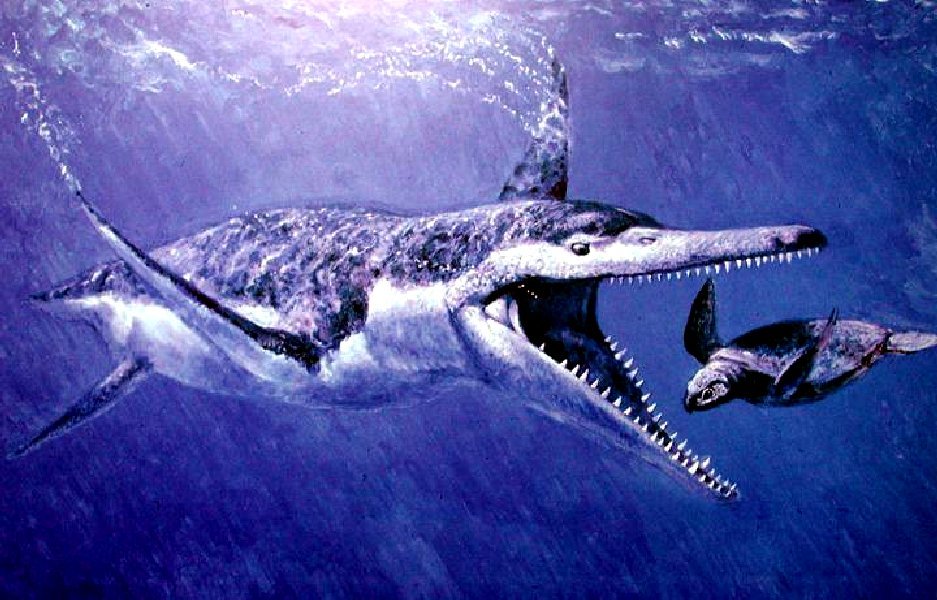
Imagine going for a lovely walk in the country. Well, you probably couldn't. Swimming in the sea is definately out, too. Just look at the terrifying Pliosaur. Although that particular picture looks like a giant crazed penguin, it would still puncture your lilo. So there'd be no days at the beach, no walking the dogs (more on them later), no picnics. Forgetting the cheese knife would be the least of your problems. Every day, people would be garishly rendered by terrible creatures just by stepping into the countryside. It would be like living in Australia, basically. Dino exterminators would make a fortune, as unwelcome giant lizards find their way into garden sheds. It would take a lot of boiling water to get rid of a nest of those things, I can tell you. They would be hunted remorselessly, blunder in front of trains, knock over power lines, eat fields of crops, and savage Tokyo with strangely blue breath.

So yes, on the one hand it would lead to untold misery and destruction, and death on a colossal scale. But it would be fun though. For a start, there's be no dogs or cats. Primitive humans wouldn't have bothered domesticating the wolf, when they could hunt using velociraptors. Pets would be a thousand times better. Forget horse racing - you could go to a sport where the mounts wouldn't just refuse to jump a fence, they'd eat the jockey. Dinosaurs were found on every ancient continent (including Antarctica), so there'd be no need to trek to deepest Africa to see some exciting large wildlife, you could just go to the local park with a frisbee and you'd hit something toothy and bad-tempered (probably not a good idea, actually). I have to say, if I co-existed on Earth with dinosaurs, I'd even start wearing Fred Flinstone-esque caveman gear - and for that reason alone, it would be fantastic.


Horizon Dinosaur Special

Thursday, March 08, 2007

Making ironing fun

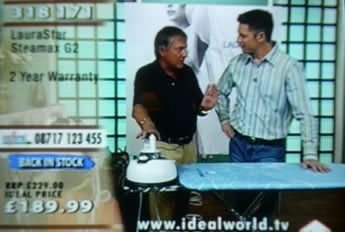
Ray and Dean letting the iron do the work

It's been a tough few weeks for the digital TV industry here in the UK. Firstly, the 'ring and win' channel ITV Play was heavily censured for misleading viewers. Basically, they pose a query - in this case 'Name an item commonly found in a woman's handbag', and you phone in to guess the answers, some of which will win cash prizes. The example they gave was 'mobile phone' - and viewers started to add their guesses - at 75p a time - along the lines of keys, makeup, diary etc. Trouble was, the answers turned out to be 'plane tickets, ibuprofen, dog, mittens, driving licence, contact lenses, umbrella, elastic band, false teeth, dog biscuits, directions, balaclava, and Rawlplugs'. Amazingly the first seven of these were guessed correctly, but miffed viewers complained to the broadcasting regulator, Ofcom, who ruled that ITV’s solutions “were not reasonable answers to what appeared to be a straightforward question”.

Then last week customers of the newly hyped Virgin Media service had some of their channels blanked from their (paid) subscriptions, because of a long-running feud between Virgin and Sky. Licensing agreements couldn't be reached, so Sky took their ball home with them and removed the content from Virgin's cable package - effectively pulling the plug on thousands of households who had already forked out money for a guaranteed service. However, this was soon brushed aside as a few days later another TV storm broke, when several leading premium rate phone ins were taken off the air as it was revealed some channels ran 'live' competitions that had been pre-recorded, so viewers calling in their answers were competing in competitions that didn't exist. One of the guilty parties was ITV Play, which was hurriedly pulled off the air.

So what's going on with digital telly? Surely this never happened in the days of only four channels. Back then, you actually had to change programmes by physically getting up and walking over to the telly to push the button. Apart from my Uncle Pete, who bought a ten foot length of cane from a garden centre, pushed a cork on the end, and used it to prod the telly from across the room (it was also perfect for prodding my brother). Today, the 'original four' - or three if you remember prior to 1982 when C4 started - have spread into dozens of others - BBC3, BBC4, ITV2, ITV3, ITV4, ITV Play (although not at the time of writing), E4, E4+1 (E5?), More 4, More 4+1 (More 5?). Not to mention the new competition, the channels from other providers that languish at the higher end of the Freeview listings (we don't have cable, or anything fancy). Are any of these actually worth watching?

A few days ago I conducted a small experiment. Between 8-9pm I randomly chose a high numbered channel, and sat through an entire hour of primetime television output, to see if really there was anything to grab the attention. I don't know what I was expecting, but if the TV producers out there are regularly chucking out the standard of programme I watched, then I can only salute them, as it was truly brilliant. I chose number 22, which turned out to be the 'Ideal World Channel', of which I had never heard. For a solid hour of open-mouthed amazement, I observed 'Ironing Solutions with Laura Star, hosted by Dean Wilson'. It was sixty minutes (plus commercials - all of which were about Ideal World's products) of two men trying to flog irons.

But no ordinary iron! (which was pretty much their prime selling point) - the LauraStar Steamax G2, with 3.5bar Swiss steam generator, multi-directional soleplate (with optional pressing soleplate), and a whopping 0.8dl boiler. Yours for a penny under £190. The show was hosted by an incredibly cheerful ironing fetishist called Dean Wilson - his bio on the official Ideal World website (yes, I looked it up) says 'Dean has been presenting live TV for 12 years and, with his unique style and cheeky approach to life, he likes to bring a smile to the faces of the viewers.' Indeed. His job was to coax us smiling viewers to parting with the cash by prompting the 'expert' into demonstrations of the iron's stunning performance. That particular expert was a bloke called Ray - and if Dean quite liked ironing, let's just say Ray probably has prefect pleats in his sexual organs.*

"I'm ex-army and I'm ex-navy and I want creases down my shirts," he said at one point, causing me to hestitate in poking fun at him. Do the armed forces have a laundry division? I suppose navy uniforms can get heavily stained.** Ray quickly got to work, steaming a selection of creased garments, some of which were crumpled by the able Dean beforehand - like when an escapologist gets a punter to check that the padlocks are real before slipping them off. In one instance, he held up a blue shirt, saying "When you get off a plane, this is what your clothes look like," before swiftly skimming the iron over a garment that looked like it had been trampled by a herd of elephants. He solemnly explained how the Steamax G2 tackled the 'three D's of ironing' - Dark (it avoids the unwanted shine effect), Delicates (causing Dean to squawk 'You can't iron that!' as he brought out a spangly chiffon sari - which of them it belonged to was never revealed), and Don't Know (as in 'I don't know if I can iron this').

It was a revelation. With this product, no longer do you have to turn things inside out to iron them. The reason being, the steam is cold - which Ray demonstrated by pointing the thing at his face and calmly blasting a jet of vapour at himself, as Dean hurriedly shouted "Do not try this at home, folks!!!". He also became something of the philosopher - "You've got to iron for the rest of your life whether you like it or not," - obviously his dual-service combat laundry experience has given him a reflective outlook. My response to that point would be 'not if the iron stays in the cupboard', but it was Dean who continually nudged us along into thinking our lives couldn't possibly be complete without this product. "I'm really passionate about this - I usually spend an hour a week at my ironing board, it took me fifteen minutes to do these jeans!", he explained, probably trying to curry favour with Ray.

For a solid hour they badgered away with this, steaming creases into pillowcases while admonishing the UK for their lax ironing standards - "Some people don't iron their duvet covers, Ray!" "I know, Dean. I know." The stock flew off the unseen shelves, in fact at one point they added extra stock - strictly against Ideal World regulations! "I don't normally do this, you know," said Dean, almost believably. They shifted the lot (although it was never revealed how many they originally had), even when at one hilarious moment, Dean pointed out to Ray that he had missed a bit and left a lapel wrinkled - "Yes, yes - but I'm doing it quickly, aren't I?" he snapped, tossing the jacket off-screen before they could get a closeup of it. So did I ring up and order one? No, of course not. But then I was busy on the phone anyway. I've got to keep my place in the queue for when ITV Play comes back on the air. I'm going to answer Rawlplugs to every question...


* or rather, Ray allegedly has prefect pleats in his sexual organs.
** Feel free to add your own joke at this point.


Idealworld.tv
Laura Star UK
Sunday, March 04, 2007

Spring in the City


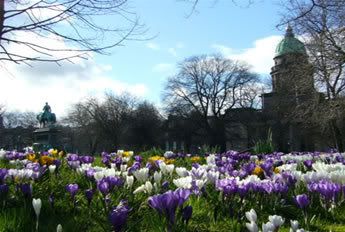
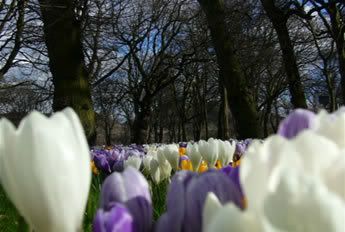
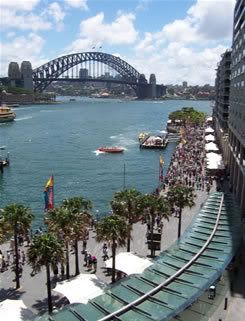
I can never remember when Spring officially begins - but the start of March is usually near enough. The first signs are always the crocuses, they sprout en masse in a multitude of colours. Here they carpet Charlotte Square in the west end of the city centre. Behind is the St. Pauls-esque dome of West Register House (it was designed in 1811 as a copy of the famous London cathedral), now home to the National Archives of Scotland. The horseback statue is Prince Albert, and was unveiled by Queen Victoria herself.


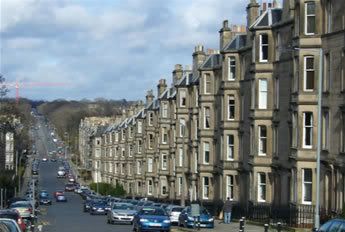
My local neighbourhood doesn't have many crocuses about, but it looks much brighter than ususal in the afternoon sunshine. The distinctive Edinburgh four-storey sandstone tenement buildings march off down the hill, windows gleaming. Here's the same view (from the other direction) 100yrs ago.


Built in 1870, Fettes College is the swankiest public school in a city full of them. Wealthy city merchant Sir William Fettes gave £166,000 (in 1815) for the education of poor children and orphans. Fees are now rumoured to be around the £20,000 mark - it has occasionally been called the 'Eton of the North', partly because of it's image, and partly because students study for English A-Level qualifications instead of Scottish 'Highers'. Tony Blair went to Fettes, and so did James Bond (Ian Fleming wrote that he had been transferred from Eton for an 'amorous incident with a maid'). Ironically, Sean Connery's pre-acting job as a milkman may have taken him here too, as apparently Fettes was near his route.


The best place for fans of the family Iridaceae to head for is undoubtedly the Meadows, where they fling themselves out of the ground left right and centre. I know nothing about Crocuses, so I looked them up on Wikipedia - as I do for most things I need to learn more about. 'The name of the genus is derived from the Latin adjective crocatus, meaning saffron yellow', apparently. Also, it turns out they do not grow from bulbs, but corms - they may look identical, but inside have a solid structure instead of a layered one. So don't let me catch you asking for Crocus bulbs again, eh?


So my crocus knowledge is zero. But I do know about the Meadows, having lived near it for over five years and walked along every inch of it's pathways at some point or another. A large semi-circular park on the southside of the city - after the Crocuses have come and gone thousands of yellow daffodils appear, by which point the cherry trees have started to blossom. Much of this is wasted on the local student populations as they scurry from their lectures to the pubs. And who could blame them?


So, Edinburgh gripped by the joys of Spring. About an hour after I took this photo, it was pouring down...

Sunday, February 25, 2007

Find this in your supermarket

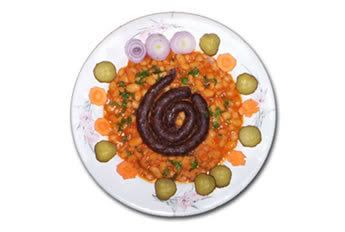
Fasole cu carnati - Romania's staple


Following on from my previous post about the UK's national dish (the mighty CTM), I've been looking into other countries' favourite meals, those that reflect who they are and their attitudes to food and cuisine. Wikipedia has a list of some of these, slightly contentious in parts - Scotland's National dishes are apparently haggis and deep-fried Mars Bars (although I've written about that before too, so I'm just as guilty of stereotyping I guess). In fact, England's other national dishes include the English breakfast, Northern Ireland's is the Irish Fry (a 'heart attack on a plate'), and Wales has Welsh Rarebit - "It is made by grating cheese, blending it with beer or a little milk and butter, seasoning (particularly with mustard), and spreading the mixture onto hot toast; the whole is then grilled in the British fashion: that is, heated briskly from above". The sick man of Europe, eh?

But what about other nations? What if you're in the mood for a Venezuelan? Or are in Tescos and can't decide between the Bryndzové halušky or the Gado-Gado? We've all been in a foreign country and pointed hopefully at something on a menu, only to have the nearby diners suddenly hush as you inadvertantly order the 'curried pelican testicles à la mode'. Hopefully you might avoid such trouser-loosening incidents if you learn a couple of popular dishes for your destination, and stick to them. Some can be all-encompassing - like the Korean speciality Bibimbap, which I first had on a plane somewhere over the Pacific Ocean. Meaning 'mixed meal', it's a DIY stew involving some or all of white rice, chicken, beef, fried egg, chilli, prawns, cucumber, courgette, tofu, carrot, radish, fish, mushrooms, doraji (bellflower root), spinach, soybean sprouts, and gosari (bracken fern stems). Apparently sometimes a leaf of lettuce may be added - but you want to leave room for the ice cream afterwards.

Stews seem to be fairly popular in the national dish stakes. Brazilians have their Feijoada (black turtle beans with salted pork trimmings [ears, tail, feet], bacon, smoked pork ribs, at least two types of smoked sausage and jerked beef loin and tongue). A good one will be dark purplish-brown, apparently. Vietnam has Phở, which Wikipedia helpfully mention is 'pronounced /fə/ or /fʌ/ by English-speakers', although my Vietnamese source told me to pronounce it 'Phur', and I know better to argue with her, don't I Lan? Eastern Europe does a good line in stews, of course - like Goulash, Borscht, and so forth.

Scandinavian countries famously enjoy a slightly acquired taste in fish products. The Swedes have Lutefisk - air-dried Cod soaked in a mixture of water and lye (caustic soda) until it reaches a pH of 11-12, putting it dangerously close to household bleach (pH 12.5). Leave it too long, and the fish fats turn to soap - saippuakala in Finnish, or 'soapfish'. Before this stage is reached the Lutefisk is soaked for another five days to make it edible, although I've never actually tried it. However I'd happily sample it if the alternative was Hákarl - the Icelandic shark dish left to putrify in gravel pits for up to three months. Dryly referred to as an 'acquired taste', fresh Greenland Shark meat is said to make people vomit blood - but rotten, it tastes of strong cheese. Mmmmm.

Staying underwater, as it were, we find the famed Japanese delicacy Fugu. An unfortunately toxic species of pufferfish, I saw them swimming around in grimy tanks outside seafood restaurants in Tokyo, and for sale at the Tsukiji fishmarket. It has been banned on several occasions throughout Japanese history, and is apparently the only foodstuff the Emperor is not allowed to eat, for his own safety. Since 1958, only qualified chefs can prepare it. Wikipedia has a great quote on the rigorous testing procedure they undergo. "The fugu apprentice needs a two- or three-year apprenticeship before being allowed to take an official test. The test consists of a written test, a fish identification test, and a practical test of preparing fugu and then eating it. Only 30% of the applicants pass the test. This, of course, does not mean that 70% die from poisoning; rather, they made a small mistake in the long and complicated procedure of preparing the dish." Wiki also reveals the most prized part of the fish - "the more poisonous testicles of the fugu can also be eaten; they contain a milky liquid and taste slightly salty." Actually, I think I'll have the shark.


How to prepare Hákarl

Tuesday, February 20, 2007

One of these is me...


How to do it...


How not to do it...


No prizes for guessing...

Thursday, February 15, 2007

Beautiful but deadly?

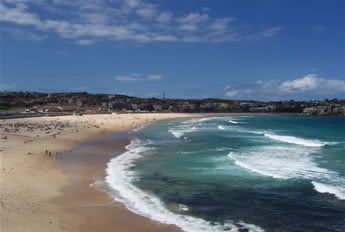
Bondi - stunning but treacherous


A while ago, to celebrate my 200th post, I wrote about some of the ways people find this blog, and the things they are really looking for. Postwise, I'm nearer 300 now, but the ways the people of the internetosphere stumble bemused onto these pages still fascinate me. As well as the previously mentioned Blogger tracking tool, I've also got a widget on my trusty, yellowing MacBook called Google Analytics - which gives me so much information about you lovely readers it's almost frightening. Graphs, pie charts, keywords, entry and exit points, it's got the lot. I can sit here in my cold Scottish castle and discover what computer you use, your co-ordinates, who you voted for on X-Factor, anything. Through this, I learned what my most popular post of all time is, and not only is it surprising, but just how popular it is is astonishing.

Just under 6% of all my readers look at this one page. They all, without exception, arrive there by typing the same four words into Google (the search engine drags in 36% of my total visitors). It was a post I wrote very early on, when I was just getting the hang of blogging - and my ramblings were noticeably shorter. In fact, as I sit here writing this, four out of the last fourteen people to read DUaB arrived here searching for that one subject - it's incredible. I have the wonders of Google to thank, of course, as if you type the four words (which I'm not revealing yet, as you may have noticed) into their search engine you get 15,500,000 results - the top hit being me. Blimey.

So why do I mention this now? I promise you it's not to blow my own trumpet - it all relates to this Guardian Article last week from the Australian Bureau of Statistics and the National Coroner's Information System, which I read while eating my lunch one afternoon at work. As DUaB regulars will know (the 34 of you that have 200+ visits each, my 'Platinum Elite'), I started this thing when I moved to Australia to let people know I was still alive and hadn't been eaten by any of the thousands of killer animals, fish and plants us Brits think live down under. Essentially some statto type (and I know I've no grounds to criticise), has worked out how many unfortunate tourists have died in Oz over the last seven years - 2,433 of them. Almost one a day.

The majority of these tragic cases are natural causes, and have to be comparable with the number of people who fall ill and die on holiday anywhere else. Take out car crashes, and the number reduces even further. But Australia does have a dangerous reputation. This article in China's People's Daily newspaper warns would-be visitors of things to watch out for, under the title 'Deadly creatures lurk amid summer paradise', and goes on at length about snakes, spiders and crocodiles. Personally, I think the wildlife dangers are over-emphasised somewhat, and when the most dangerous native creature here can dish out a slight nibbling at worst, we tend to freak out at the merest glimpse of something scaly, or eight-legged. Or at least I do.

Apart from my close encounter with a very large spider, the only dangers I rountinely faced were from the local takeaway curry house on Victoria Street. But my frankly weedy swimming ability meant I deliberately didn't expose myself to one of the greatest risks of Sydney life - the beaches. I don't mean sharks (although there have been two attacks recently), but the currents. Australian beaches are iconic - and none more than Bondi. But it has a fearsome rip tide, and continually people get into trouble without realising the risks. Already in 2007, eight people have drowned in the city. 210 had to be rescued over the course of the last weekend in January, as temperatures soared into the 40's. Bondi sees a lot of rescues, as new arrivals visit what is arguably the world's most famous beach, and go into the water unaware of the danger.

But do foreigners really think down under is so dangerous, or is it just a much played-upon stereotype? Well, that brings me back to the most popular DUaB post, and those four most searched for words. They are 'Bad Things About Australia'. Be prepared...but don't be put off...


'Bad Things About Australia' DUaB post (1st December 2004)

Australia's fatal charms claim thousands of tourists [Guardian]
Australian Bureau of Statistics website

Thursday, February 08, 2007

Things I learned this week

Where's the duckpond?


Last Sunday was the Superbowl - the orgy of consumption and over-excess that signals the end of the American Football season. I stay up every year to watch it, and traditionally take the following day off work. Even when I was temping in Sydney I managed it, although temps weren't allowed time off - I mysteriously succumbed to a case of 'Superbowlitis' and couldn't come in on that Monday. Miraculously I had recovered by the Tuesday. These 24hr bugs, you know how it is. Anyhow, this Monday gone I was off work (legitimately) and spent most of it sat on the sofa in my lounging trousers in a hungover fug of lack of sleep, sore eyes, and several hundredweight of tortilla chips very, very slowly working their way through. Comforted by the warming feeling of the Macbook on my lap - and boy do they get warm - I fell back on the best way to spend a lazy hour(s) - trawling Wikipedia for facts. Here's what I found - I pass on these titbits, in the hope that you too will grow as a person from having discovered them. May your laps always be warm.


1. The Smallest Park in the World
[park (noun) - a large public green area in a town, used for recreation]. I'm not quite sure what kind of recreation you would be able to do in Mill Ends Park, Portland. Forget the frisbee. Leave the dog at home. At 0.3sq metres, you'd probably struggle to walk your pet woodlouse. Created in 1948 as a refuge for leprechauns to hold snail races (I kid you not), the park sits in the middle of a pedestrian crossing cunningly disguised as a flowering pot plant. But it was fully inaugurated in 1976, and at less than two feet across, makes for a fun (and brief) day out. Link


2. The Saint who didn't go quickly
Saint Teresa of Ávila is the patron saint of Spain, Croatia, headaches, and lacemakers. She founded the Discalced Brethren in November 1568 - 'discalced' being a fancy term for 'shoeless', apparently (one for crossword addicts there). She once had a rather painful-sounding vision - a seraph repeatedly driving a golden lance through her heart - after which she cried out what became her motto - "Lord Let Me Suffer Or Let Me Die" (I think every saint has to have a catchphrase). Someone up there obviously has a sense of humour, as she died at midnight on the 4th of October 1582 - the exact moment Spain switched to the Gregorian calendar. To fit this new system, the day after jumped directly to the 15th of October, the Lord therefore letting her die peacefully in her sleep over the course of 11 days that never existed. Link


3. The Ploughman's Lunch Deception
'A ploughman's lunch is a cold meal - featuring at a minimum, a thick piece of cheese, pickle, crusty bap or chunk of bread, and butter. It is often accompanied by a green salad; other common additions are half an apple, celery, pâté, sliced hard-boiled egg or beetroot.' Pâté? Keep all those EU subsidies rolling in! But the article continues...'In Britain ploughing is usually done during winter. At that time of year the ploughman’s wife or mother would have been unlikely to include salad in the ploughman’s lunch. Err, yeah. I guess. 'Green vegetables would be difficult to get in winter.' Hmmm. I smell a rat. 'A real ploughman's lunch would have more likely consisted of just cheese and pickle.' So...so what's the deal? 'Lexicographer Edwin Radford in To Coin a Phrase (1974) attributes the current usage to Richard Trehane, chairman of the English Country Cheese Council.' The buggers! Working in cahoots with the English Crusty Bap Council, no doubt. Link


4. How many mice live on the Tube?
Half a million, give or take - covered in brake dust so they appear black. London Underground facts have their own Wiki entry, and there are some fascinating pearls amongst them. Five stations are named afer nearby pubs: Angel, Elephant & Castle, Manor House, Royal Oak and Swiss Cottage. The shortest distance between stations is 250m - Covent Garden to Leicester Square on the Picadilly Line (which your author has, for some reason, timed at 19 seconds). If you buy a single ticket for that journey you'll be paying the equivalent of £25 a mile. The recording of "MIND THE GAP" is spoken by a studio sound engineer, after the actor hired to read the line insisted on royalty payments and it had to be re-recorded after he had left. And if you think the Tube smells bad - on the 23rd March 2001 a specially created fragrance called 'Madelaine' was pumped into Picadilly Circus underground. It was discontinued after a single day as it made people feel sick. Link


5. 110 million editors can't be wrong
Well, they can - Wikipedia isn't an exact science. The site's most innovative selling point is also it's biggest source of controversy. Allowing anybody to edit articles leaves Wiki open to error, feuds, lies, and practical jokes. Ranging from my mate Craig's attempts to prevent people cluttering up his favourite listings with pointless waffle, to the man who was sacked from his job for creating a fake biography of his boss, linking him to the Kennedy assassination. The scandals must be good publicity - Wikipedia is currently the 12th most popular site on the internet. In case you were wondering what people actually use it for, the ten most commonly read pages out of the 1,626,814 articles it contains are: Wiki statistics (3.9m views per day), Wikipedia Main Page, Saddam Hussein, Sex, United States of America, Naruto, (a manga series) Wii, Gerald Ford, List of Sex Positions, WWII [as of Jan '07 - List in full]
Link

Friday, February 02, 2007

Bottom 100 Mammals

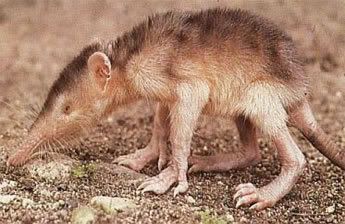
'Scruffy overgrown shrew' in action...


"For every action there is an equal and opposite reaction" Newton said once - although apparently he said something far more complex, but was probably babbling after getting brained by that apple. There are similar sayings and philosophies, like that credit card advert where someone does something clever so around the world another person has to be stupid to act as a counterbalance. Basically, it seems whenever anything good happens, there could well be a bad turn around the corner. Only a few months ago, I brought you the story* of the Cypriot Mouse, a brand new species of mammal discovered in Europe. It may have escaped your attention over the festive period, but recently we lost a species of mammal - albeit from slightly further afield.

The 2006 Yangtze Freshwater Dolphin Expedition travelled almost 4,000 miles in two weeks along the Chinese river, with monitors constantly scanning the yellowy water for one of the animals, known in Wuhan as Baiji. But they didn't find any. The co-leader, a Swiss scientist called August Fluger, said afterwards "We have to accept the fact that the Baiji is functionally extinct". Under the gaze of the world's cameras, a species vanished. River dolphins have slipped through the murky waters of eastern China for 20 million years, and have now become arguably the first large mammal species eradicated by human activity in the modern era (that we know of), especially when as recently as 1980 there were over 400 in the very same river. There are four other species of freshwater dolphins in the world, all critically endangered.

This brings me to a list. The Zoological Society for London (ZSL) have recently launched a new organisation called EDGE of existence, with a remit to '...conserve the world's most Evolutionarily Distinct and Globally Endangered (EDGE) species by implementing the research and conservation actions needed to secure their future'. By sending scientists to work with local experts and wildlife students in the countries where these species live, they can hopefully give these amazingly rare animals more of a chance. You, the public, can donate money to schemes to help the creatures and the students involved. Targeting individual types of fluffy things designed to appeal isn't new in conservation - but EDGE are doing things slightly differently, in that the things they are after might be fluffy, but most of them sure aren't cute.

The New Guinea Big-Eared Bat is one of them, and it may be too late for them as well. EDGE have released a list of the 100 most critically endangered mammals in the world, with the Baiji an unfortunate (and now possibly absent) number one. The NGBEB hasn't been seen since 1890, when an enthusiastic collector bagged 45 at once, and may have destroyed an entire species in one field trip. The top, or as it should probably be - bottom - 100 mammals left may be only 95 at the moment, the Vietnamese Leaf-Nosed Bat hasn't been seen for 60yrs, and is only known from a single individual. EDGE use an interesting system to work out which animals to concentrate on - those that are ecologically distinct or unique and are on the IUCN Red List, so putting more emphasis on unusual species.

Of course, the Giant Panda and Blue Whale are featured, but then also are such incredible oddities as the Handley's Slender Mouse Opossum, which is so rare there's no picture of it, and scientists don't know exactly where it lives, what it eats, or how it reproduces. Apparently it's quite slim, though. What about the Senkaku Mole? Confined to a single 4km island, they were only discovered in 1991, and are currently under threat from 300 goats trampling their burrows. The undoubted cutest of the lot, is the Long-Eared Jerboa, but there are other things with wierd and wonderful names, like the Hainan Gymnure, the Dinagat Moonrat, and the Hispaniolan Solenodon.

Predicatably because they sound strange, and look strange, most of them are incredibly strange. The solenodon (of which there are two in the top five) resembles 'a scruffy overgrown shrew' and produces toxic saliva that it injects through snake-like grooved fangs. The Sumatran Rabbit is so rare that locals don't have a name for it in their own language - which must present a problem to visiting well-meaning biologists. The Golden Bamboo Lemur exists solely on poisonous bamboo shoots, consuming 12 times the lethal dose of cyanide for most other mammals every day. The Volcano Rabbit rather unfortunately lives only on the slopes of lava-spewing mountains on the outskirts of the food-deprived population of Mexico City. I could go on. These things are incredible, and need your support. Who would want to live in a world without scruffy killer shrews and volcanic bunnies?


*Or I read it somewhere and quickly re-hashed it


EDGE of existence 100 List
Zoological Society for London
2006 Yangtze Freshwater Dolphin Expedition

Sunday, January 28, 2007

'Normal blokes cocking about'

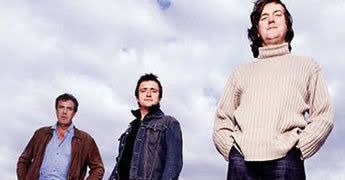
The Top Gear team (L-R) Clarkson, Hammond, May


8pm to 9pm Sunday evening was one of those TV head-to-heads that cause bickering across the nation's living rooms. On BBC 1, Kevin Costner's hauntingly timeless portrayal of Robin Hood Prince of Thieves went more or less completely ignored (and not just because of that bloody Bryan Adams song), as the live finale of Celebrity Big Brother went up against the start of the new series of the motoring programme, Top Gear. It'll be interesting to see the viewing figures for the major channels - I'm not holding out much hope for Channel Five's rerun of the Nutty Professor in that particular battle. Rather, 'Five' as the channel is simply referred to these days. I'm sure inevitably it will become '5ve', then just '5', then 'ƒ', or something. The nation's remotes, clickers, zappers, widgets (depending on where you come from) were doubtless fought over as the UK chose between feckless gits hooting at the stupid and racist; and Big Brother.
For the uninitiated - and in this case that basically means for the non-Brits reading this - the annual slagfest of Celebrity Big Brother has this year been crapped to a new low by the gormlessness of Jade Goody and the rest, but then spectacularly enlivened by allegations of racist bullying from three female celebrities towards the Bollywood actress Shilpa Shetty. Tens of thousands of complaints from members of the public launched police investigations, caused questions to be asked in the House of Commons, and even the burning of effigies in the streets of Shetty's Indian home city. Oh, and soaring ratings. With the future of the Big Brother format hanging in the balance, and even the future of Channel 4 uncertain as well - London Mayor Ken Livingstone called for them to be stripped of their franchise for their racism, which is a tad rich coming from him, I think - Shilpa won the contest by a landslide public vote.

But going against that - and if I was still a betting man, getting more viewers than it - was the first episode of the ninth series of Top Gear. Again, for my international friends, it's a light-hearted topical motoring show with a mixture of fast cars, reviews, and mindless pyrotechnics. Having said that, the show's Wikipedia entry says right near the beginning that it has 350 million viewers worldwide, so you probably already know about it. Presented by three 'normal blokes cocking about' to use their own words - Jeremy Clarkson, Richard Hammond and James May - the franchise was rejuvenated in 2002 after being cancelled the previous year due to falling viewing figures. Since then the knockabout format has pulled in the public, and also a few Emmy's and BAFTA awards. But the series 'rocketed' to the UK's attention when a landspeed attempt last summer went appallingly wrong, and almost killed Richard Hammond in a 288mph dragster crash. Tonight, in that first new episode they showed the footage of the accident, and the nation tuned in.

I don't think I ever used to watch Top Gear, even in the musty days of Quentin Wilson and Tiff Needell - and certainly back then Big Brother was just a glint in a Dutch TV executive's eye. Since Jeremy Clarkson took over presenting duties, it was banned in our house - along with anything featuring Noel Edmonds, Jeremy Beadle, or Tommy Cooper (the latter for a very good reason, which we don't discuss). And I certainly don't watch Big Brother, ahem, of course. However, having said all that, Clarkson can be - look away now Dad - highly amusing. For instance, here is his review of the Vauxhall Vectra VXR - a vast improvement on the Mark One Vectra, which he reviewed by 'remaining mute and drumming his fingers on the roof of the car for a full minute.' Yet it's also highly annoying at the same time. I just don't get it.

You get the feeling that the producers of Big Brother would leave a dead hooker in the house to generate ratings, so the BBC's decision to wait until now to show the footage of Hammond rolling through the grass is fair enough, I guess. I did watch it - if nothing else to get the info so I could write this post - and it was rather odd to see the studio audience essentially cheer him for not dying. But it was handled well, after the usual cocking about - and a rather amusing attempt to repave a section of road in 24hrs - they showed the tape and had Hammond describe what was going on. At almost the exact time over on Channel 4 Shilpa Shetty was being crowned the winner of BB, an item which made second place on the BBC's 10 o'clock news (Hammond's return was the next piece).

So why do I like watching Top Gear? It crassly glamourises speed - something the show's producers adamantly deny - it gives Clarkson a stage for his sometimes iffy sense of humour, and tonight's celebrity guest was Jamie Oliver, for pity's sake. I have no interest in cars, I've never driven or even had a lesson. I don't know one end from another, when they talk about horsepower and transmissions and stuff they may as well be talking a foreign language. They rely far too much on daft stunts, blowing up caravans and soforth, and they do it all in front of a braying studio audience of sycophants. But it's great. I can't explain it, I watch it every week, feeling slightly dirty. Of course, when put up against Big Brother, I'd quite happily watch anything. Even Kevin 'I'm Rah-bin of Lock-ersley' Costner on the other side...


Apologies over 'racist abuse' on BB
Official Top Gear website
Top Gear presenter critically injured
Top Gear's Hammond cheats death
Youtube clip of Top Gear's aquatic car challenge