Wednesday, September 28, 2005

Photos from Tsukiji


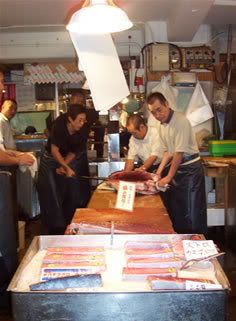
Here are some bonus photos of the scenes at Tsukiji fishmarket, to give you a better idea of what delights were on offer. This picture above shows a group of workers scything a tuna carcass in half using what looked to me like a ninja sword.
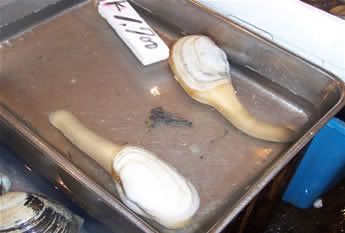


These cockle-like shellfish were about the size of a large potato each. Obviously popular as there were only two left, I can't imagine what you would do with them. Well, cook them and eat them, I suppose.
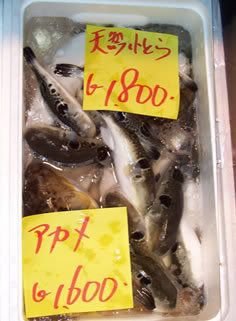


This colourful jumble of fish are the much-prized fugu - blowfish (or puffer fish as we would call them in the UK). According to things I've read, the actual taste is a bit bland - but they are eaten for their excellent texture and of course the sheer thrill of eating something poisonous that has the capacity to kill you. People do die eating it - albeit not that often. There's apparently a famous fugu saying that you should always let your dining companion take the first piece...
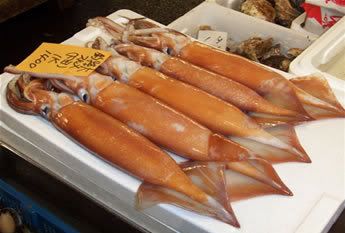


Arm-length sized squid all neatly laid out - everything was very well presented.
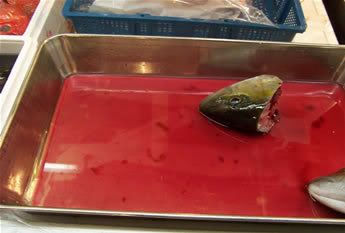


We arrived at 8:30am and a lot of the action was over. It seemed to me that the best bargains had gone early. We were wondering what happened to things like this head, and thought that there's probably someone who buys things like this for fish stock or animal food. I doubt much is wasted.
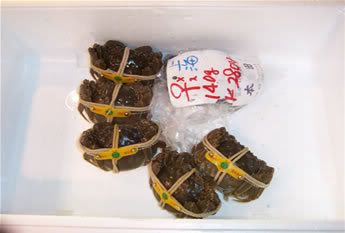


Live crabs trussed up for easy boiling. It was hard for me in places - I'm a fan of marine things of course - but I do like seafood, so of course you have to know things like this happen. The sushi breakfast we had afterwards was wonderful...

Tuesday, September 27, 2005

Tsukiji and Asakusa

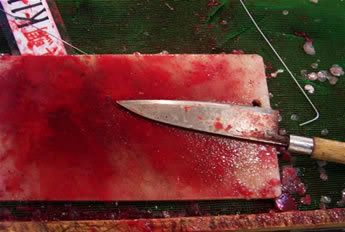
Plenty of blood and guts at the fish market


So, fishmarkets. I remember going to the indoor fish market in Preston when I was young and staring at the fillets of cod and haddock behind the glass. A few years ago I went to the Sydney fishmarket and saw the computerised auction of prawns and seafood. Today I added another fishmarket to my collection - and one that is surely impossible to top. Tsukiji fishmarket in Tokyo is simply staggering. Every day 2,500 tonnes of seafood are sold there (a bit more than bought by the old women at Preston market). The daily bill for all the fish sold comes to Y2.9billion - that's GBP15m (or US$26m for my American readers) - and they only trade for 5 hours. GBP3m per hour in marine life. Amazing.

The market is just as I imagined - maintaining the theme I was talking about yesterday. It was frantically busy and seemed completely chaotic, but was very organised at the same time. Each stallholder had a set area of floorspace, and a tiny wooden hut at the back where a person sat to take the money. We arrived at 8:30 (it opens at 5am) and already a lot of them had sold out, shut up and gone home. As for what was on sale - just about anything. From bags of 1cm-long see-through baby eels to tuna heads the size of sheep. All kinds of fish, both dead and alive, shellfish - including mussels almost at long as your forearm, crabs, octopus, squid.

Walking between the narrow lanes of stalls was a mission, with buyers and workers rushing everywhere. Motorised pallet trucks zipped all over, transporting white polystyrene boxes around. Outside a mountain of these two stories high was piled up - after all, 2,500t of fish need a lot of boxes. We wandered around trying to avoid getting in the way, and just looking at the sheer variety of things on offer. One thing I wasn`t prepared for was the blood - all over the hanger-sized building men were hacking and chopping, using lethal-looking axes, knives and hooks to dismember unfortunate creatures who were only swimming around that morning. But hey, I`m no hypocrite - we went for a sushi breakfast at the market and it was amazing.


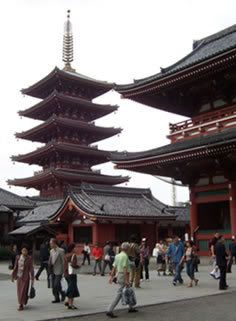
Beatiful pagoda at Senso-ji temple


After Tsukiji we walked for a few minutes to the Hamarikyu-teien, or detached palace garden. It was here that the early shogunate hunted ducks, and so wanted a more picturesque setting whilst they were waiting for the birds to fly into their nets. The garden sits on the edge of the Sumida, and is surrounded on the other three sides by skyscrapers. From there we took a boat ride up the river to the old shopping area of Asakusa. The river cruise was interesting, but both sides of the Sumida have been channelled, dredged and built up so much it was very industrial. Still good though - interesting to see how people live so close to the water.

Asakusa has been a centre of entertainment, religion and shopping since the 13th Century, and is one of the parts of old Edo (Tokyo in the time of the Shoguns). We walked around and looked in the millions of small touristy shops on Nakamise-dori before the giant Senso-ji temple. Another Buddhist temple, this one is for Kannon - the Goddess of Mercy, and was founded in 628 after two fishermen pulled a statue of her out of the Sumida. A temple has stood there ever since. It was interesting to watch people praying - unlike yesterday`s remote temples Senso-ji is bustling and active. You could pay Y100 and take a paper fortune from a drawer - they can be either good or bad. Mine was a 'Regular Fortune' - apparently 'talk with tongue entangled by your getting drunk gives no unpleasant impression to others'. That's always good to know. My Mum had two attempts and my Dad one - all three were 'Bad Fortunes' of marriage and financial strife ahead. Fortunately if you tied the piece of paper your fortune was written on to a nearby wire rack, it negated it and you were back to square one - with nothing bad hanging over you. Handy that...

Monday, September 26, 2005

Ohayo gozaimasu

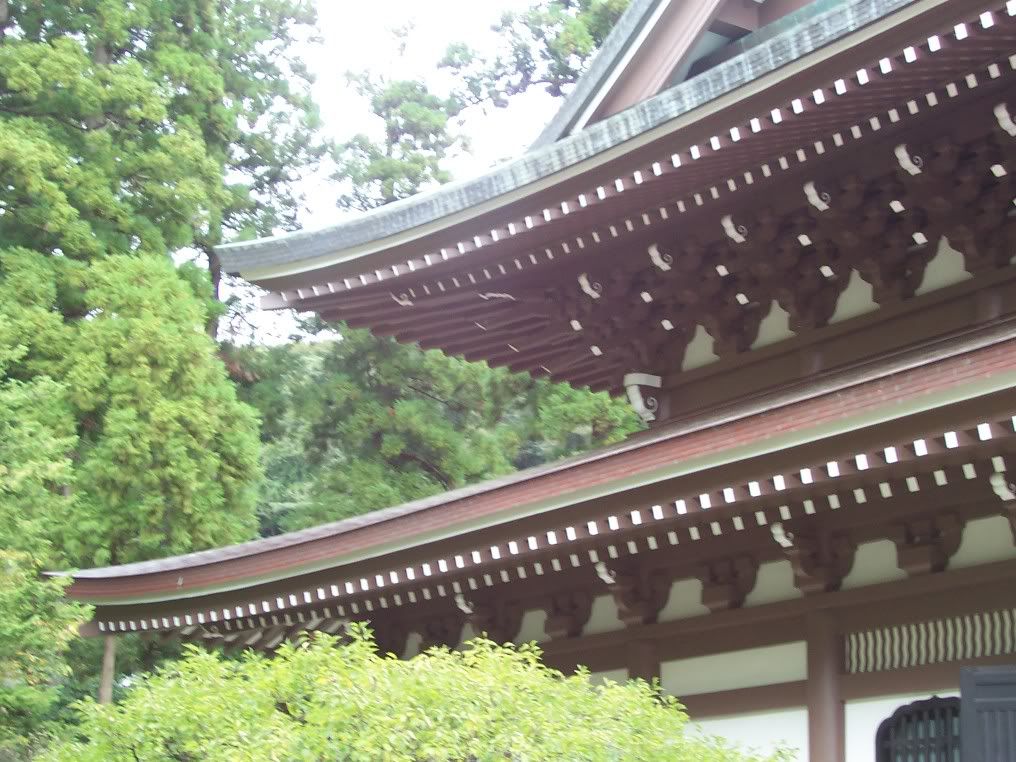
Detail of the roof of Engaku-ji temple


Well here I am. I`m writing this on a kanjii-enabled keyboard on the 7th floor of our hotel in Shinagawa - the Shinagawa Prince. I`ve only seen hotels like this when I was in Las Vegas all those years ago - it`s enormous. There are thousands of rooms - the hotel is divided into about half a dozen buildings and has it`s own shopping mall, aquarium (with shark tunnel and dolphinarium), two cinemas and an IMAX, two bowling alleys (two!) and sixteen restaurants. It`s mammoth - essentially a city within a city - within a city, as Shinagawa is huge as of itself. Anyway, we arrived with no problems from Sydney, as overnight flights go it was reasonable. The plane had a party of 104 Japanese schoolkids returning from language schools in Australia, but they were down the back of the 747.

So what are my first impresssions of Japan? Well, I`ve spent so long planning this trip, reading about it, etc, that it was pretty much as I was expecting. That`s not to say it was a disappointment - the exact opposite, it`s amazing. Tokyo is so vast, so busy, so hyped with energy. The 25th floor view we have overlooks the grey tower blocks of the central city, merging with the smoggy haze hanging over the city. In the distance we can see the Bladerunner-esque lights of Shinjuku glittering away. Eveything is fast paced, people bow to you, taxi drivers wear white gloves, there are vending machines everywhere, Japanese TV is bizarre - it`s all present and correct. You just have to go into a supermarket and see how alien a place you`ve arrived in. I can`t wait to explore more tomorrow.

Dad at the Tokeiji temple


Today was by necessity a slow day, as we arrived off the plane at 6am. We converted our JR passes - the multiple-use rail ticket that covers all of Japan`s JR railways for two weeks - and were given an immediate train reservation for the Tokyo express that left within three minutes. So after legging it down to one of many platforms we were soon winging our way into the city. Fortunately our hotel is near the station, but unfortunately we arrived at 10am and couldn`t check-in until 1pm. So we left our bags with them and had a GBP15 cup of tea in the cafe before taking a train trip. Oh - that`s GBP15 for three of us, by the way, not each. We caught a local train from Shinagawa via the port city of Yokohama to Kamakura - an early centre of the Buddhist faith. We spent the afternoon wandering amongst leafy temples and cemetaries, looking at crows, eagles, and amazing butterflies. The trees looked ancient - some of the sites were constructed in the 1300`s. After a few hours the tiredness set in and we returned to the city. It was a short, but good, introduction to the Japanese way of life (and death) and was a great way to spend an afternoon. Tomorrow is the first full day, and it`s going to start nice and early...(again)

Saturday, September 24, 2005

Near to the off...

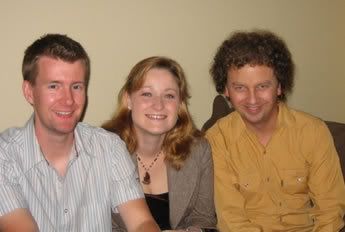
The pre-dinner photo


Well, these are now the last days for me in Australia - tomorrow I'm off to Tokyo. I spent most of the day today sorting out my stuff - which to be honest didn't take all that long. I made a conscious decision not to acquire the usual amount of crap that I tend to do when I'm living somewhere, as I knew I'd have to either throw it away or somehow carry it all home. In the end I had to buy a small suitcase-type thing to take care of the overspill from what I'm taking to Japan. It only cost $18 (GBP7) though, so no great expense. Even so, it took me a few hours to organise what I am going to need over the next couple of weeks and what I'm not. Oh - and in the afternoon I watched the AFL Grand Final and cheered the mighty Swans on to their first Premiership for 72yrs. Go the Swans.

Tonight I went out for dinner in Surry Hills with my flatmates (see picture above taken beforehand), to a very fancy Thai restaurant. The prices were similar to the French place we went to a few weeks ago but the portions were about twenty times the size. I ate so much that when we went for a drink at a nearby pub I could hardly finish it. Unlike me, I know. Anyway, so that's it for my stint living in Sydney. Tomorrow it's off for two weeks in Japan - which I can't wait for. I've been planning this for so long that when our plane rolls up to the terminal in Narita I'll be hopping about like a 3yr old at Christmas. Expect lots of photos and a fair bit of blogging. Oh yes. After the two weeks there, I'll be back in Sydney for 24hrs (the 11th October if you're taking notes) and then from there it's a flight to Seoul and another overnight stop on the way back to London. Bring it on! See you in Tokyo...

Tuesday, September 20, 2005

WA Coast day 4

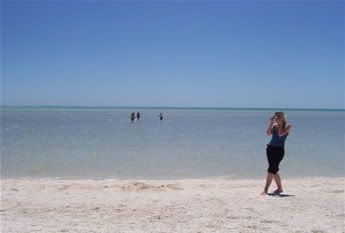
Taking photos at Shell Beach


The four days went very quickly, but I always knew it was going to be a fast tour. The final day of my trip was more relaxed than the previous three - we set off at 10:30, for one thing. I had a wander on the beach at Coral Bay before we got underway. We drove up to Exmouth and checked into our holiday park hostel, which was pretty good value for $20. Exmouth was founded in 1967 to support a US submarine tracking base. We rolled through it and round Cape Vlamingh (he of Rottnest Island fame), which today houses the mothballed Harold Holt Communications station - the Australian Prime Minister who vanished off the face of the earth whilst out for his morning swim in the 60's (not here though). Today they site is abandoned, and lies rusting under the unyielding sun. The peninsula is famous for more than that however - the Ningaloo Reef lies off the Western tip. The Ningaloo is Buzz Aldrin to the Great Barrier Reef's Neil Armstrong, but is quietly becoming more popular. The big draw there - apart from the usual coral - are the Whale Sharks that cruise lazily up the coast from May to July each year. Wrong time of year for us, though.

We stopped off at Turquoise Bay - a beautiful snorkelling spot. This was your classic tropical reef beach - white sand, clear water, warm breeze. Steve the driver produced a battered box of snorkelling gear, and we all had a go. Although being a pretty rubbish swimmer, I saw a few different kinds of fish in waist deep water - although it would have been great to go out over the reef - I'm just not good enough to negociate the currents. Still, it was great to see the fish that close up, and I can't think of a better way to spend an afternoon, really. It was great.

On the way back to the holiday park things got better, though. We drove up to the Vlamingh lighthouse and Steve produced a box of wine and a pile of plastic cups, so we had a drink and watched the sun go down over the Eiffel Tower-sized communication pylons. Out in the bay, a series of splashes caught our attention, and suddenly a humpback whale breached the waves and crashed back into the sea. It was stunning - they were a long way out, but we were high up enough to see them all coming out of the water. Every 30 seconds a whale would come up for air, or splash out of the water. We saw two go almost completely out of the sea before slapping back with a huge white plume. That more than made up for the cancellation of my whale-watching tour in Kaikoura (which seems like such a long time ago). We weren't as close as a boat trip gets you, but these were wild whales splashing around in the afternoon - and we were up on a hill overlooking the sea it felt as if they were putting on a show for us. It was breathtaking - and a great way to end my trip. I flew back from Exmouth to Perth with a huge smile on my face...

Monday, September 19, 2005

WA Coast day 3

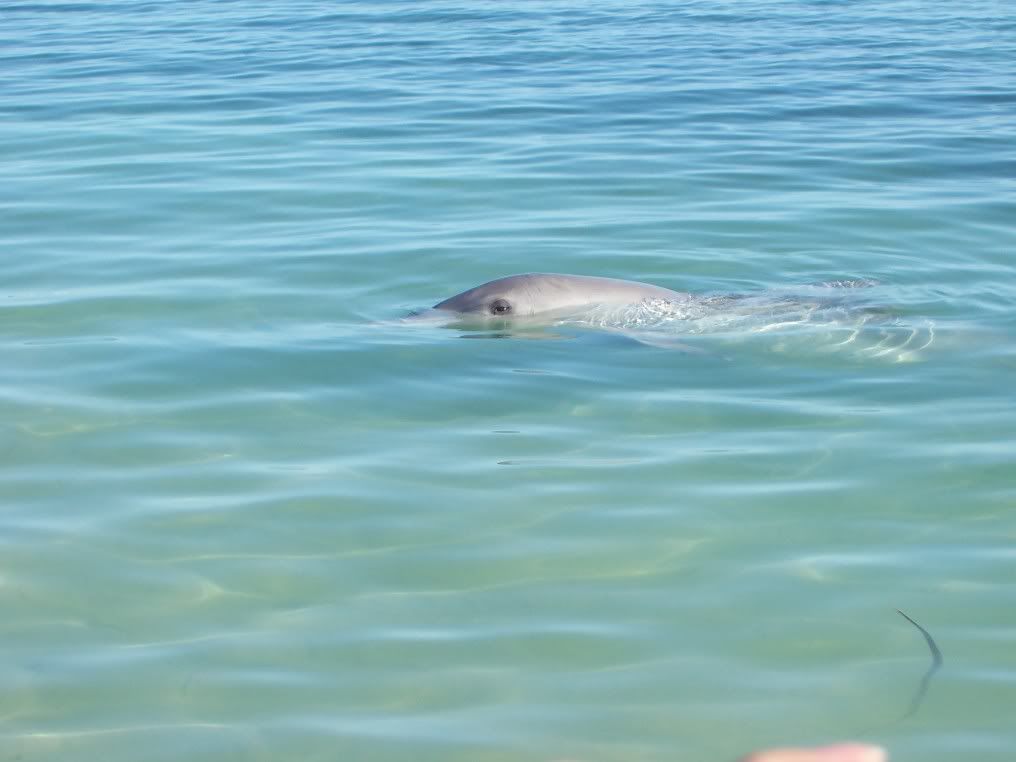
Dolphin checking out the crowd at Monkey Mia


Another dawn start today, but a chance to get as close to wild animals as you can get without jumping in the water. We saw a few native species on the trip - kangaroos (two of them boxing), a wombat, emus, wedge-tailed eagles, whales (more on that later), and dolphins. Just east of our second overnight stay at Denham is a place called Monkey Mia. 'Mia' means 'place of' in the local aboriginal language, and the Monkey was an early trading vessel that anchored in Shark Bay. For years a group of local dolphins have arrived at the beach each morning and are quite happy to swim in knee-deep shallows looking at tourists. They are fed - but carefully and are only given 5% of their daily needs so they don't become reliant. I'm not sure about that, but it was incredible to stand there and be a metre away from wild dolphins swimming around. You got the impression they were amused by it too - every so often they raised an eye out of the water and had an inquisitive peek. Of course, it's really popular, and there were about 100 people in a long line on the shore - but the dolphins don't seem to mind. You can't go any closer though, and touching isn't allowed - apparently human viruses are lethal to them.

After that we had a choice - go on a catamaran in the bay, or go for a nature walk with an aboriginal guide. Now I've been on plenty of boats - but have never talked to an aboriginie, so I chose that. It turned out that I was the only one - so I had a private tour of the bush for a couple of hours. The guide was called Capes, and was a member of the local Malgana people. I've lived in Australia for almost a year and done nothing aboriginal, so I was interested to hear what he had to say. We walked around, and he showed me tracks of the various animals and birds in the dark red sand. He talked about the influence of nature on their way of life - it's everything to them - and their outlook on how to conserve it. He explained how they catch goannas to eat - they listen for alarm calls of bush wrens, and use them as a guide for where the lizards are likely to be. He was pretty good at bird impressions, he did an alarm call and all the wrens flew up to check out the danger. It was all interesting, he picked a few native beans for me to eat - they tasted disappointingly beany. We saw loads of lizards and birds, but no mammals or snakes. He knew a heck of a lot though, and told me that schoolchildren in the Denham area are now learning aboriginal language in their school - even the white children. Oh, and that his tribe call ants 'mingers'.

Sunday, September 18, 2005

WA Coast day 2

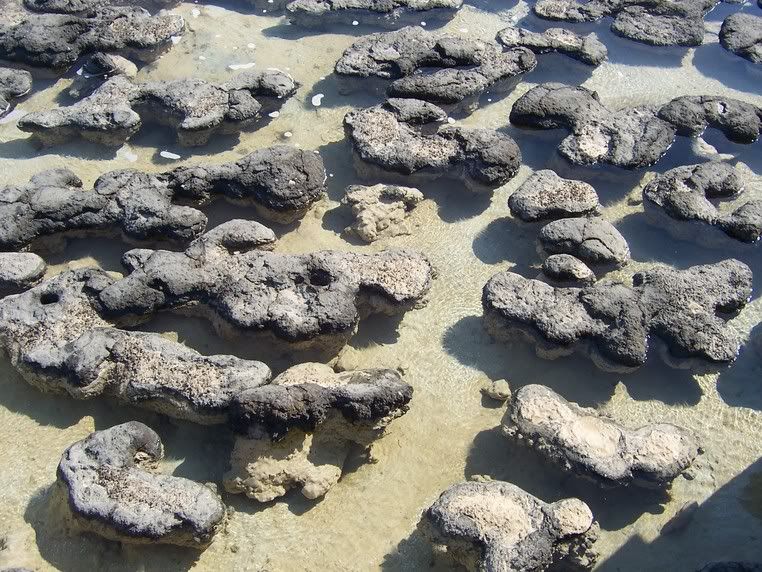
The Stromatolites at Hamelin Pool, Shark Bay


This morning started early - we set off at 7am every day, so get all those stereotypes about lazy backpackers out of your heads! There was a lot of dozing on the bus though - try riding for three hours in 25C heat and stay awake, it's tough. The first port of call today was close to our overnight stay at Kalbarri. We had a walk down one of the famous gorges - Kalbarri National Park has over 1000sqkm of them, so we had it to ourselves. At the bottom was a trickling river dyed a stunning green by massive amounts of algae. WA is home to all kinds of natural animals, but also feral foxes, goats, rabbits and pigs. There's a fence that runs along the length of the state border to keep them out, but it seems to be a losing battle. Fortunately there's a natural poison that all local animals are immune to, but introduced species aren't. There are a lot of poison warning notices everywhere.

One place we stopped in the afternoon was at Hamelin Pool - a special site for all biologists as it's one of only two places in the world where you can see living Stromatolites. What are they? Well, they are groups of simple bacteria that decided to live together in a colony for safety and produce a rocky home for themselves. Ordinarily, these footstool-shaped rocks would be unspectacular, but when you realise this action was the first instance of single-celled life joining together the importance strikes you. That moment was when simple life started the long path that resulted in everything else, including us. Stromatolites have been quietly going about their business, unchanged, for 2000 million years. They used to cover the entire planet, and did so for far far longer than all other forms of life put together. These rocks are special - and now they are only found at two salty bays on opposite sides of the world (the other being in the Bahamas). Hamelin Pool has every UNESCO World Heritage qualification there is. The examples in the photo are almost 3000yrs old. If you know me - you can imagine how stunning I found this. It was brilliant.

Saturday, September 17, 2005

WA Coast day 1

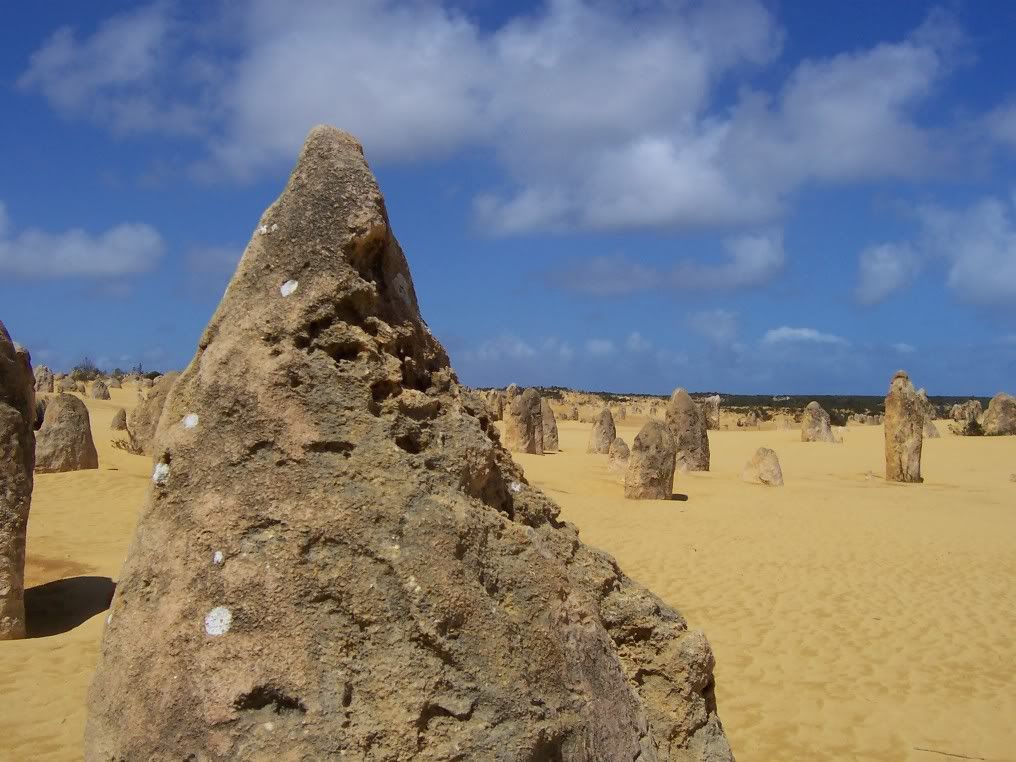
The Pinnacles Desert


The only real way to see the coast is to get on a tourist bus and be driven about - at least if you can't hire a big 4WD and do it yourself. I booked myself on the Easyrider bus tour and had a four-day trip up the coastline of Western Australia from Perth to the northern reef destination of Exmouth. They do love those UK place names in Australia. It was very similar to the trip I took in New Zealand - the same kind of 'jump-on, jump-off' idea, but again I hadn't the time to jump off so I did the trip in one go. Actually as I write this they are still going as the trip continues to Darwin and takes almost two weeks.

The first stop was the Pinnacles Desert - aptly named as you can see. Hundreds of thousands of limestone pillars are scattered around the sand, and you can wander around anywhere you like. Early ship-bound explorers looking at the land thought it was a ruined city, which maybe explains why they kept crashing into reefs and sinking. It was very impressive, and I could have spent hours there - but bus travel being what it is we were off after half an hour. Still, it was worth seeing. The Easyrider buses run every four days - so if you wanted to jump off you really needed plenty of things to keep you occupied until the next one turned up.

The main difference I noticed with the NZ trip (and of course this is blindingly obvious) was the sheer distances involved. In NZ we would stop every hour or so and look at something, but here in WA there was hour after hour of arid scrubland and bush rolling past the windows. Have a look at an atlas - Western Australia is simply huge. It's the same size as India - but with 0.5% of India's population. This is a big, empty country. But a spectacular one...

Friday, September 16, 2005

Where Quokkas Rule

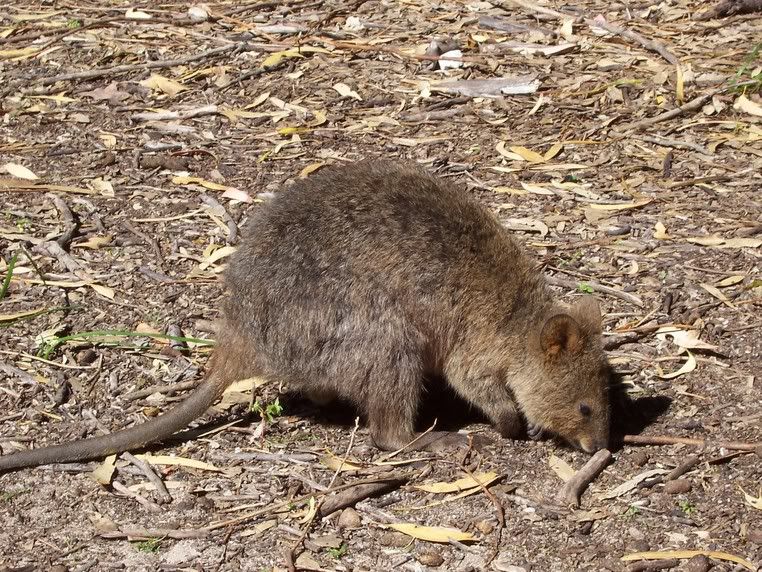
Not a rat - a Quokka


In 1696 the Dutch explorer Willem de Vlamingh avoided wrecking his ship like so many of his compatriots, and discovered an island off what became Fremantle. His men were amazed to find it covered in giant rats - much bigger than the ship rats they were used to. They camped for a couple of days, and then sailed away North leaving the furry mammals in peace. They named their discovery Rottnest Island - Rat's Nest. They were wrong, of course - the animals weren't rats, they weren't even mammals. The Dutch explorers became one of the first groups of Westerners to see marsupials, and the first ever to see Quokkas.

Once common over all of WA, Quokkas are now extremely rare - but thrive on Rottnest Island thanks to the isolation. A 20-minute boat trip from Fremantle, Rottnest is a small fish-shaped island perched on the edge of the Indian Ocean. I spent most of the day there, wandering around the beaches and paddling in the stunningly clear water. The island is famed for the white sandy beaches, and the wind keeps the temperature down when it gets too hot. Holiday homes dot the bays, and people have been coming here for many years. The island has a controversial past too - aboriginies charged with breaking settler's laws (concepts which most of them didn't understand of course) were sent to Rottnest to be interred.

So that's the Perth part of my trip over - for now at least. I'll be back here in a few days. Tomorrow I've got a 7am start on a bus trip up North into the Pinnacles Desert and the Kalbarri National Park. I'm not sure what internet access will be like up the WA coast - but if I can find a terminal I'll let you all know how I get on...

Thursday, September 15, 2005

Freo to the locals

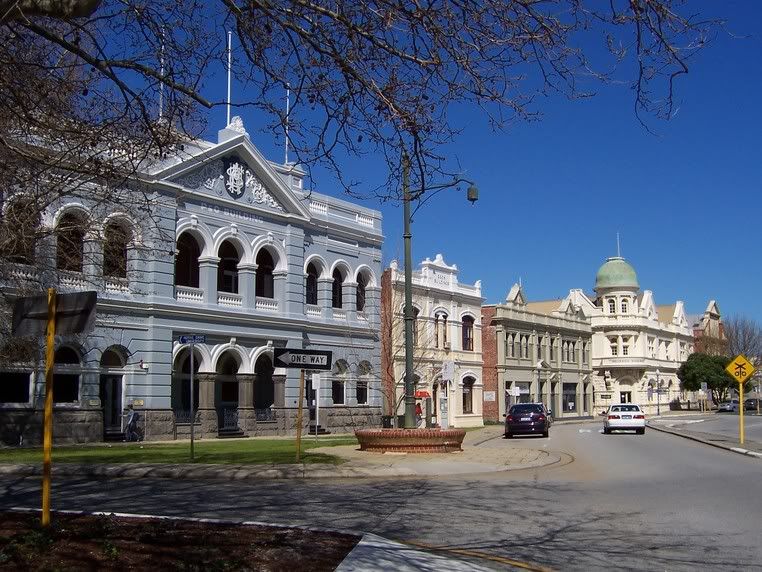
Old dock-type buildings in Fremantle


After wandering around Perth late yesterday I realised I'd pretty much done it. So today I took a train out of the city and visited the neighbouring port city of Fremantle. 'Freo' as the locals call it, is about 20mins from Perth, and is a proper working port, with massive container ships loading up right near the centre. The buildings have that old warehouse feel to them, and the ornate plasterwork everywhere reminded me of the restored docks in Hull. That's about it for that comparison though, as it was gloriously sunny and the air didn't have a fishy tang to it. I wandered around for a bit, admiring all the porty-goings on. Both Perth and Fremantle have one major bonus for tourists (and pensioners and students too, come to think of it) in that every bus that crosses the city centre is free. So you can hop on and off as much as you like - provided you know where you're going, of course.

I consulted the famed LP guidebook, and it led me to the 'stunning' and 'fascinating' Maritime Museum of Western Australia. It could quite easily have been both of these things, but unfortunately it was also 'half-closed' for 'renovation', so I'd whizzed around it in about 20 minutes. Still, that meant I went next door into the Fremantle Motor Museum - and that was much better. I'm no petrol-head (still have never got round to driving), but the cars there were great - including some old Formula 1 classics, which really got me interested. The entire collection is owned by one man (presumably a very rich man) - and he was there in overalls tinkering with one of the displays, doing some renovating of his own.

I know I said in an old post that I'm a museum junkie - but I outdid myself in Freo. In the afternoon I went to the Museum of Shipwrecks, and that was the best of the lot. They had all kinds of exhibits - apparently Western Australia is littered with wrecked ships from the hapless Dutch traders who ploughed into the rocky shores whilst trying to work their way up the coast to the then Dutch East Indies (Indonesia). The museum gave the impression that the Dutch were practically hurling their ships onto the hostile shores - particularly the Alhobros Islands (the name means 'look out'). If you're ever in Fremantle I urge you to go - it was fantastic, and I learned all kinds of things I'll be looking out for when I go up the coast on Saturday. But tomorrow - I'm off to look for giant rats...

Wednesday, September 14, 2005

The most isolated city

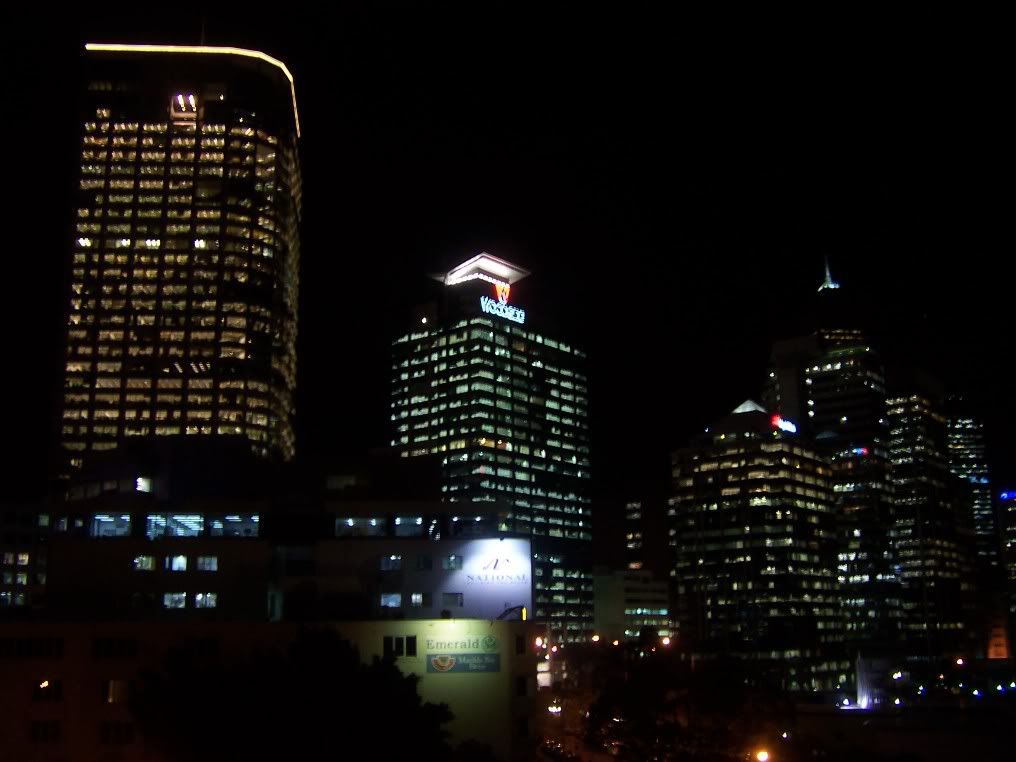
The Perth skyline at night


So the start of the 'month of travels' began this morning with a whopping five-hour internal flight across to the other side of Australia. Now if you're American or Russian, flying that long and still being in the same country isn't new - but to me it certainly is. I was trying to think of how many countries I could get to within 5hrs of Edinburgh, but gave up when I was well into double figures. They don't call Perth the 'most isolated capital city on Earth' for nothing. It's closer to Singapore than Sydney. I got a ramshackle bus into the city and found where I was staying fairly easily - Perth is very small. Although maybe I've been in the spectacularly sprawling mass of Sydney for too long to appreciate the smaller cities.

My flight over was reasonable, considering the cold I've picked up - the last one I got was the last time I went travelling - and the hangover I had saddled myself with after the final Japanese lesson. It wasn't much of lesson, more a end-of-term meal and piss-up. We went to a Japanese lesson and had a great meal - which Nobuko-san instructed us to order in Japanese. She also ordered bottles and bottles of steaming sake, which we kept polishing off with increasingly loud cries of 'kampai!!'. I tell you, warm sake does wonders for a blocked nose. So that's it for my return to student-hood, I'll be able to try it for real in a couple of weeks.

The night ended on an amusing note, when the bloke I sat next to for the lessons confused me with another bloke in our class, and gave me a couple of anime DVD's. Hey, I do watch it - but I'm not the fan he thought I was. I managed to duck most of his questions, and took the disc home. I didn't feel bad, as the guy it was intended for didn't show up, and it wasn't bought specially - just downloaded from a laptop onto a blank disc. At that point we were both pretty drunk, and he seemed pleased that I'd taken it. So I've got some anime to watch when I get back - my Japanese education continues...

Monday, September 12, 2005

Tour Guide

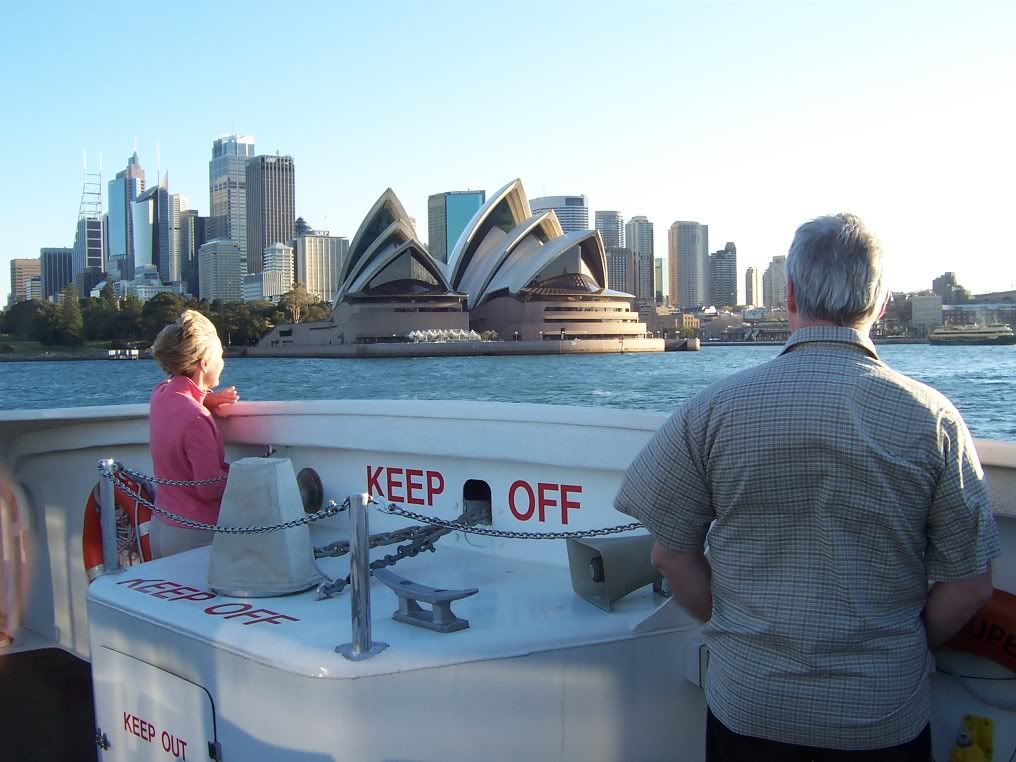
M&D take in the harbour view from a ferry


If you've been wondering why the flurry of activity has died recently on DUaB, it's because I've been employed as a tour guide for the past week. My parents arrived on the 3rd of September and I played the part of tour leader. Initially this involved me getting up at 4am to meet them off the plane from Singapore, and watch as the evils of jetlag took hold and they slipped into the traveller's fug (before lunch, no less). But after a couple of half-days at the beginning of their stay, they attuned to the Antipodean timeframe and were keen to get out and about. We were undone by the weather to begin with - rain and cold winds for the first couple of days. My carefully-planned itinerary quickly went down the tubes and I spent much of the rest of the week winging it.

They had eight days in Sydney, all told, so managed to see practically everything the city has to offer. We did all the usual central attractions - Opera House, Harbour Bridge, Botanic Gardens, Taronga Zoo etc. I tried to get them out on the harbour ferries as much as possible, and I think they appreciated the city more for that (see photo above). We also took in day trips to the Blue Mountains and the Hunter Valley, both in spectacular Spring weather. I'd not been to the Hunter before, and thoroughly enjoyed it.

So they are now off up on a Barrier Reef cruise, and my tour guide duties are on hold for a while - at least until we get to Tokyo and I can show them round a city I've never visited. Tomorrow I fly off to Perth and the gaping expanse of Western Australia. I've got just over a week there - doing the backpacker thing again - before I come back to Sydney for my final 3days in Australia. How time flies, eh? Look out for more blog posting over the end of this week as I get on the road again.

Wednesday, August 31, 2005

The end of work

You'll be seeing more photos like this from now on...


Count the days between today and the 7th of November. That's how long I've got until I'll set foot in an office again. Yes, today was my last day at work. The 'working traveller' part of my visa is over - I'm just a plain old 'traveller' again, or backpacker, if you will. Call me what you like (and I've heard most of them), I'm a free man again for a while (until my scheduled return to the NHS in Edinburgh).

Not that I minded working - far from it. I was fortunate enough to land myself with a great temp agency, and managed to get myself put into two jobs which I enjoyed. Well, maybe enjoyed is too strong a word, but if they were menial they were at least varied, so I was never doing one thing too long. And no data entry, either. I'm certainly not contemplating switching careers to the enigmatic worlds of Superannuation or Human Resources, but they did they job for me (and me them).

On my last day today, the two women I work with took me out to lunch, and then presented me with a bottle of wine (from the Hunter Valley, naturally) and a cartoon of drunken kangaroos (not half as bad at it sounds). I handed over my pass and the key to my office, and that was that - back to civvy street.

So tomorrow I'm off to an accountant - first time for everything - clutching mounds of paperwork and a hopeful expression. I've been told by my agency that this Lithuanian bloke they know is good for getting tax back for us working travellers (again, he's not as bad as he sounds, apparently). They take out a $110 fee and I get the rest back within 10 working days. If that happens, blimey, I'll be well chuffed.

After that, my parents arrive this weekend, so I'll be doing my tourguide impression for a week or so. Then hopefully I'll be jetting off to WA for at least a week, and then it's briefly back to Sydney before I go to Japan. Almost wrote an entire post without mentioning that... ;)

Saturday, August 27, 2005

Please enjoy the image which overflows

There are times when time it cannot modify


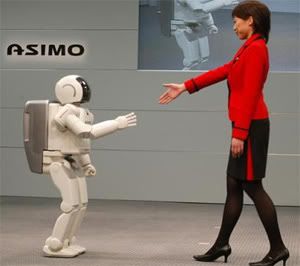
Who doesn't love shonky translations of Japanese websites? Google usually takes a pot shot at translating, and the results are always more entertaining than the websites themselves. Take these - from the homepage of the Honda Welcome Plaza in Aoyama, Tokyo. I particularly love the notes on ASIMO (a recently developed high-tech robot). Executions three times a day? Bring the popcorn!


Concerning the exhibition please inquire to HONDA smile of the information counter concerning question and the catalog claim of the four wheel car & bicycle general-purpose product.


The ASIMO it participates as a HONDA welcome plaza Aoyama's role of the guide. Introduction of the program which is televised with multiple vision and the guide et cetera of various events which are done at the plaza, everyday are done. Furthermore in forum and event, chairmanship part of opening! In the ASIMO which participates at the plaza, by all means, please come to meeting.

In the midst of ASIMO demonstration execution!
1 day 3 time schedule
10:30 - 10:35
11:50 - 11:55
15:00 - 15:10
* There are times when it modifies with the circumstances of the event and the like.


Both four wheel car & the bicycle, the new model of topic and model of popularity, in life the general-purpose product and the welfare car et cetera which participate are displayed. Actually you sitting down in the seat, please try atmosphere and handling feeling et cetera, freely. There is also a colourway of the body. Please request the unclear point and question, with ease.


Even from now on with HONDA welcome plaza Aoyama, regardless of the two wheels ・ four wheel the event which you can enjoy to everyone it is in the midst of planning. Concerning future schedule, because it keeps publishing to event news on occasion, don't you think? propriety everyone please check!

Wednesday, August 24, 2005

As easy as 123

Supotsu-ka!


Last night's Japanese class produced a language rule that completely amazed me - different counting systems are used depending on the shape of the object you're counting. In English we would say 'three bananas', or 'three postcards', but in Japanese the words used to correspond to the number three above would be different. There's the -mai system, which relates to things that are flat (plates, tshirts, slices of pizza etc), and the -hon system for things that are cylindrical in shape (bottles, trees, fingers etc). If you happen to be counting something that's of an indeterminate shape - like potatoes, televisions, lions - you use the more regular hitotsu, futatsu, mittsu (i.e. 123) system. The -mai and -hon systems above are combined with the other 123-system - ichi, ni, san etc. However the hitotsu, futatsu, mittsu system only goes up to ten - after which you swap to the ichi, ni, san system. Confused? As you can imagine this led to a barrage of bewildered questions that verged on the philosophical - How thick does a book have to be before it ceases to be flat? How would you count trees that have fallen over? What if the pizza's deep-pan?

The second half of the lesson was spent looking at Japanese words that have been developed from English. They look almost unrecognisable when written phonetically, but when you see the word 'sanoitchi' next to a picture of a sandwich, you get an idea of the prononciation. Japanese is of course an ancient language, so modern inventions are less likely to have 'original' names - like 'kamera', 'terebi', 'sutereo' - and my personal favourite 'tepu-rekoda'. Try saying them aloud and the meaning becomes clear - if you want to do some baking, you might put on an 'epuron' beforehand. In a department store you'd go down an 'esukareta' between floors - and maybe come back up in an 'erebeta'. And if that special someone bought you a 'purezento' - you might tell them those three little words - "Ai rabu yu".

Monday, August 22, 2005

How to boil rice

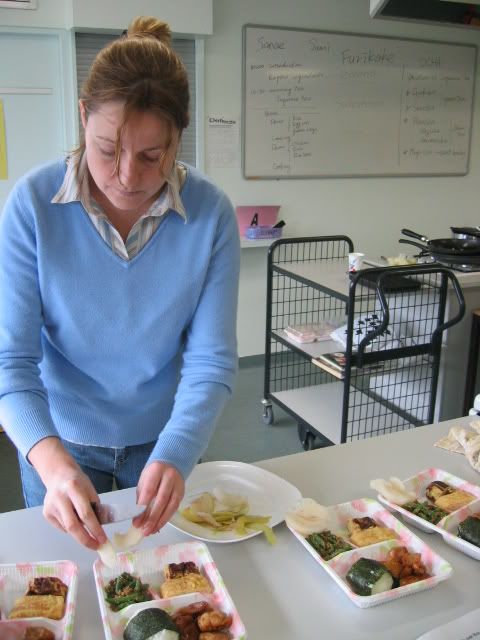
Geraldine finishing the obento


My near-total immersion in all things Japanese continues apace - whether its reading about the country, studying the history, learning the language, or defeating her armies on Battlefield 1942 at my local LAN gaming cafe. This weekend I added another string to my Japanese bow by learning how to cook proper Japanese food at a college course. I had noticed the one-off course when I was signing up for the language school, and suggested it to my flatmate Geraldine who is also a fan of raw things on rice.

The course was held in a school in Leichhardt, an area with a large Italian population a short bus ride west of the city centre. There were about 15 people in the class, run by two Japanese ladies. I've never even considered going to a cooking class before, but I've got to say it was pretty good. There was a mix of people there from the older serial mature student types down to working travellers like us. After a quick introduction to Japanese food, we had a traditional elevenses of green tea, rice crackers wrapped in seaweed and a 'healthy snack' - small bags of flaked almonds mixed with tiny dried fish. I do mean tiny, the longest of these dehydrated guys was about the width of my thumbnail. They reminded me of the neon tetras I used to keep as a young lad. Still, they tasted pretty fishy - and went well with the almonds.

We learned to cook chicken teryaki, salmon, bean salad with sesame dressing, egg roll, and rice balls. The method of doing the rice was interesting, as it took ages, but produced amazing sticky rice - the proper stuff. You have to knead the rice under cold water until no more starchy stuff comes out, apparently - then leave it for half an hour before you start cooking it. I just boil it for 20mins and drain the scum off - but no longer! We watched while Sumi-san did a demonstration, and then divided into groups of four and did our own versions. We were paired with a couple of students (the young variety) who enjoyed themselves despite having almost no cooking skills - but the food we made was amazing. At the end each foursome had prepared their very own Japanese obento lunchbox and we all sat down to eat. It really was good stuff, and thanks to the course, I now know how easy most of it is to rustle up.

Sunday, August 14, 2005

On the trail of Billy Blue

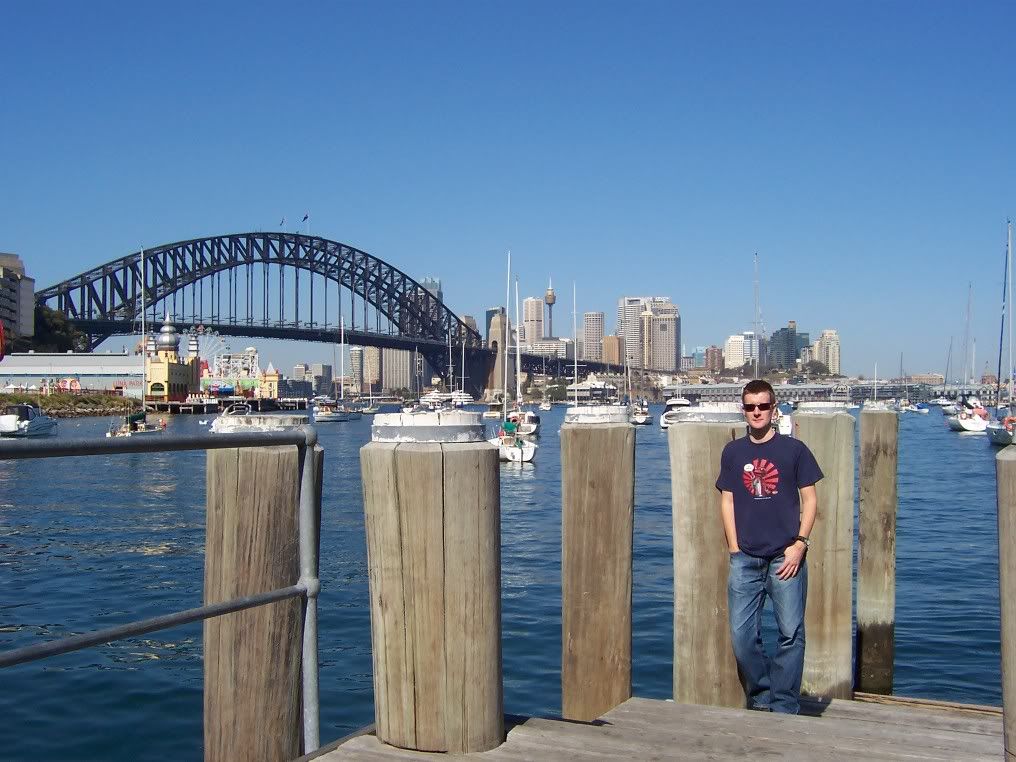
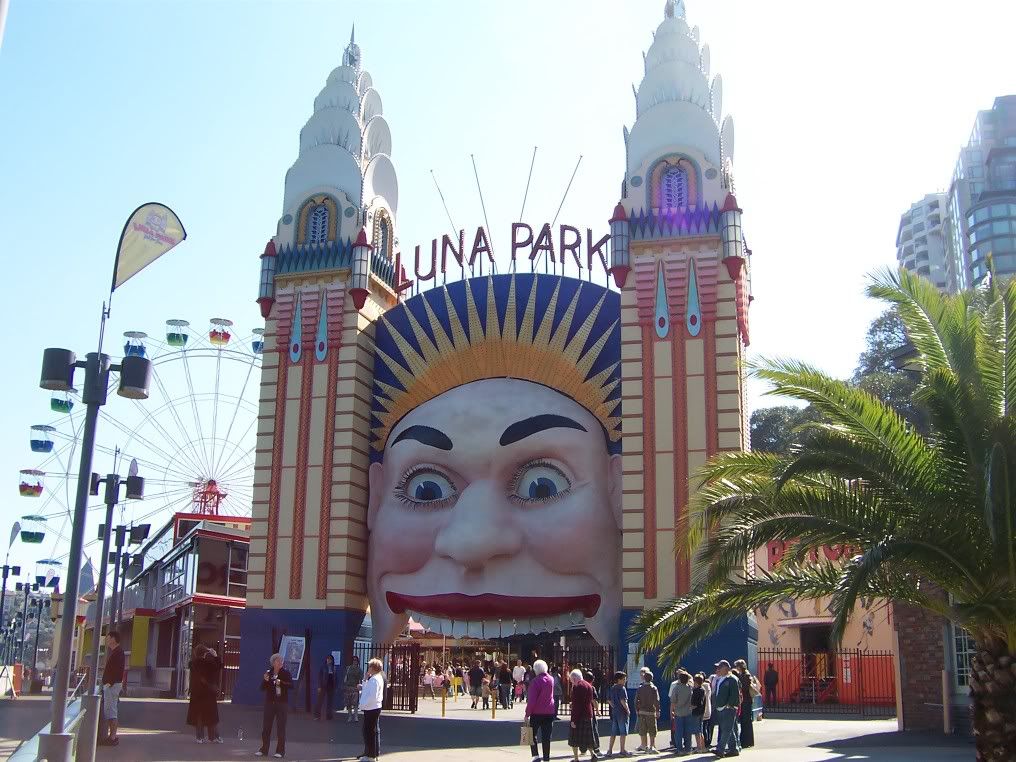
Luna Park - Sydney's controversial fairground


Yesterday I took a short hop over the water to North Sydney, and walked back down to the harbour. One of the closest spots you can reach to the other side is at Blues Point Reserve, a small spit dominated by a large tower block. Universally derided since it was built, Blues Point Tower is consistantly voted Sydney's ugliest building, although to me it's no worse than any other concrete tower block. Of course very few concrete tower blocks are built within a few feet of Sydney harbour, and with views back to the bridge/Opera House/etc. If it wasn't there, the site would only be full of swanky condos I imagine.

One of the first people to live on that spot was a colourful character named Billy Blue. A Jamaican, he was transported for stealing a bag of sugar, and after his sentence ended he acquired a rowing boat and became a ferryman. The first to help people across the harbour, Blue was something of an eccentric. By 1807 he was a local legend, seen shouting at people from his boat (he ended up with a small fleet of rowing boats). Awarded the title 'Water Baliff' by the Governer of the colony, Blue preferred to be called the 'Old Commodore' and dressed in full naval uniform. He got so eccentric that eventually he would refuse to do the rowing, and his passengers would have to do it themselves. He demanded people salute him as an officer, and would entertain people with tales of naval adventures. When he became too infirm to take to the boats, he was granted the patch of land where his ferry started, and when he died aged almost 100, it was named after him.

A short jaunt around from Blues Point is the Luna Park fairground - the monstrous gates of which are something of a local landmark. They are illuminated at night, and can be seen from Circular Quay, like some kind of grinning troll sitting under the far end of the bridge. The fairground opened in the sixties, but was closed after a catastrophic fire on the Ghost Train killed about half a dozen children. Eventually it re-opened, but has struggled since to pull in the punters. It always seems reasonably busy, but I guess the lure of fairgrounds has faded for kids these days. The locals over at Milson's Point hate it - they get the screams and banging music from 10am to 11pm every day - it obviously intrudes on their pristine views. Maybe they should move to the Blues Point Tower, which is always said to have the best views in the city - as it's the only view where the Tower isn't in it...

Wednesday, August 10, 2005

13 into 10 doesn't go

Kyo wa ii tenki desu ne


Last night was lesson three in my Japanese course - and the difficulty levels have soared compared to the first two weeks. I'd only just learnt how to count from 1-10 - this week we covered asking the time, telling the time, counting to 100, days of the week and months of the year. Some are relatively easy, like the last category there - January is 'month-one', February 'month-two', March 'month-three', and so on. Telling the time is much harder - for 11:30 we would say 'eleven-thirty' - this translates as 'juichi-ji han desu'. 11:40 is 'juichi-ji yonju-ppun'. It's pretty tough, especially when spoken quickly.

Counting to 100 is reasonable, once you've mastered the premise that Japanese numbers are similar to the French system - 20 is 'two-ten', 30 'three-ten' etc. It just takes a long time to learn. As Nobuko-san said when our faltering voices tried to say 67 'rokuju-shichi' 'Numbers are killing you'. It doesn't help that three of the basic numbers - 4, 7, and 9 - have two alternative sayings. 4 as a number is commonly 'shi', but 4 written as part of a phone number is 'yon'. If you get mixed up, both are understood, but essentially you have to learn 13 numbers to be able to recite the top ten. 'Japanese is a moody language' admitted Nobuko-san, to which we all admitted 'Hai. So desu'...

Monday, August 08, 2005

Birthday feast(s)

How many candles?


Last Wednesday was my birthday, and although the thought occurred to me to take the day off, I decided to work as normal - no such thing as free time off for us temps. It wasn't that bad really, the people at work got me a cake and then the two women I work for in the HR department took me to lunch at a nearby Marriott hotel. It was a gloriously sunny day, so we sat outside on a patio with a few conference delegates and the droning traffic to keep us company.

When I got home the food-related celebrations continued as my flatmate Geraldine cooked an outstanding curry for me, which we ate in true birthday style - in front of the telly. Afterwards she disappeared and came back with the cake from my work (they made me take it home) covered in candles. I'd not had to blow out candles since I was a kid, so gave it one almighty puff - and succeeded in removing the top layer of shaved coconut all over the carpet. Still, I got most of the candles out as well.

My other flatmate was away then, so the three of us went for dinner last night to a French restaurant in Surry Hills. Whenever you read a description of Surry Hills, the word 'bohemian' is usually in there somewhere. Essentially the area is a bit grubby, but down to earth and with a lot of hidden restaurants, bars and galleries. I suppose it all depends on your definition of bohemian - or if you even care. Still, the restaurant we went to was very good - proper French food, very tasty, very little of it, piled in artful towers in the centre of the plate. It was expensive ($50), but good - although I could have eaten everything again - as Gerard said "There's a bowl of Weaties at home with my name on it."

On the way home we stopped in a pub for a couple of drinks, and arrived just before England beat Australia by 2 runs in an incredible finish to the 2nd Ashes Test. The result caused a fair bit of shouting, and predictably a fight broke out - Surry Hills is popular with Brits for the cheap rental prices. The lone doorman did his best to get in the middle, and did a good job of chucking out one side (the Australian) and barring the other (about five English lads - who were getting quite a kicking) from leaving. It spilled out onto the street eventually, but everything had cleared away by the time we left. Still, it gave me something to write about, eh?

Monday, August 01, 2005

Away from Home

Palm Beach (left) and Station Beach from Barranjoey Head


I went on another exploration on Sunday, this time to the far North of the Sydney boundary. Imagine, if you will, getting on a bus in the centre of your city and being driven for 1hr 45minutes. Not a coach, or long-distance vehicle, but a regular city bus. The L90 goes such a distance, from Central Station to Palm Beach. My 40-minute journey to work passes 11 fare stages (i.e. 11 places where the fare increases slightly). The trip to Palm Beach passes 29 - although even then it costs only $5.20 to get there (just over GBP2). It's a long way to Palm Beach.

But is it worth it? Well, sort of. It's a nice beach, the waves were the most impressive I've seen for a while - certainly the loudest. Palm Beach itself lies along one side of Barranjoey Head, a hammer-shaped spur that juts out into the mouth of the Hawkesbury River where it meets the Tasman Sea. I walked up a trail that wound up a forested hill to a lighthouse, with impressive views around. Back down by the beach seaplanes took off regularly, shattering the silence as they battered across the water to gain elevation.

I'm told that nearby Whale Beach is even nicer, but didn't have time to get down to it. I'm also told that they film the outdoors portions of the soap Home and Away around these beaches, although I've never seen it, of course. Ahem. It was certainly a good place for a Sunday afternoon stroll, but in my opinion there are nicer beaches nearer to the city (within 20 fare stages at least).